









How Google AI Overview Selects Content – Algorithm Cues & Signals

Formerly the Search Generative Experience (SGE), Google AI Overview summarizes information from multiple web pages right at the top of the SERP results. But have you ever wondered how Google’s AI Overview selects content?
To help you understand that, we’ll break down what current research and SEO experts say about the algorithmic cues and signals Google’s AI looks for when selecting content. We’ll cover what Google AI Overview is, why it matters for SEO, the key factors that influence selection, and how you can optimize your content accordingly.
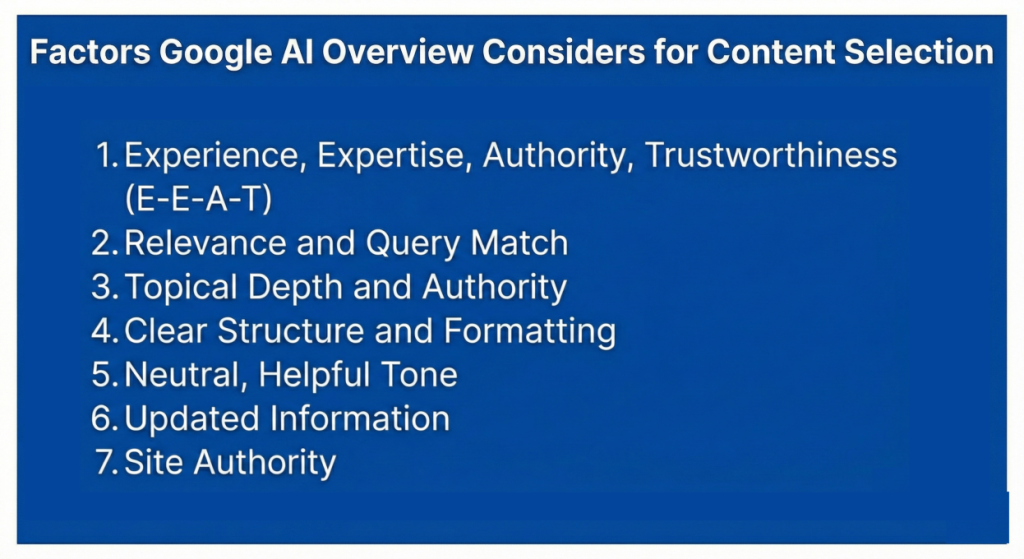
Google AI Overview features content that satisfies the following factors:
➡️Experience, Expertise, Authority, Trustworthiness
➡️Relevance of topic with searches
➡️Depth and topical authority of the content
➡️Clear, easy-to-follow structure
➡️Updated and new information or data
➡️Authoritativeness of the website
Use a non-salesy tone, an answer-first approach, updated content, FAQs, simple structures, authentic data, and continuous online monitoring to optimize for AI overviews.
- What Is Google AI Overview?
- When and where do these AI Overviews appear?
- Why Google AI Overview Matters for SEO
- How Google AI Overview Selects Content
- How to Optimize for Google AI Overview Selection
- Is Optimizing for Google AI Overview Same for an LLM like ChatGPT?
- Challenges of Optimizing for AI Overviews
- FAQs
- Summing Up
What Is Google AI Overview?
The AI Overview is Google’s AI-powered summary box that appears at the top of search results for many queries. The feature helps users and searchers get quick answers with LLM citations regarding what they are looking for.
Instead of showing just a list of websites, Google AI Overview synthesizes information from multiple sources to create a cohesive answer to your query. Each fact or point in the overview comes with a link to the source website. So you can click through for more details.
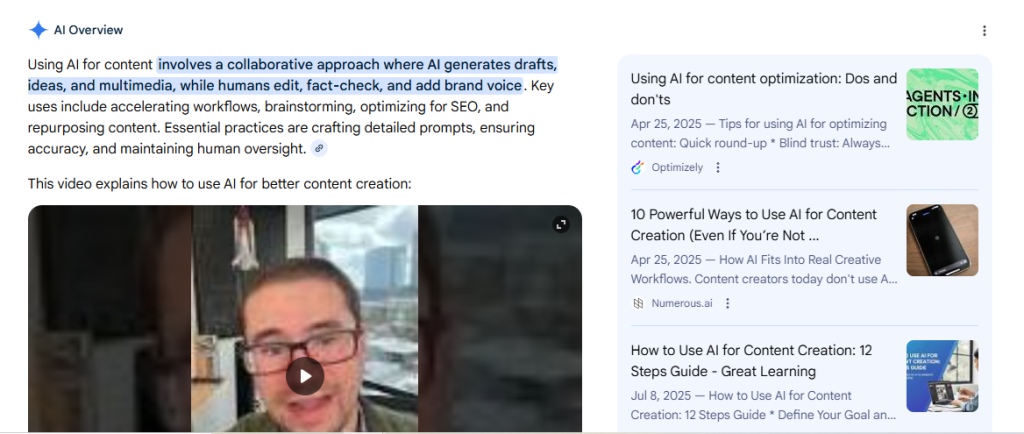
If you search “What are the top AI content tools?”, the AI Overview might present a brief list of top protein powder options with notes on each, pulled from 3–5 AI tool websites, all within a single answer box. The goal is to deliver quick, factual answers (with references) without requiring you to click multiple results.
When and where do these AI Overviews appear?
Google AI Overview tends to show up most for informational or complex queries. Early data suggests it appears for roughly 60-70% of searches that are informational in nature. These could be questions like “How does X work,” comparisons (e.g., “Hydrafacial vs. Microneedling”), or broad knowledge topics.
Google’s systems only trigger an AI Overview when they determine it adds value beyond the regular results. Simpler queries or very local/transactional searches skip AI Overview and stick to traditional results.
Why Google AI Overview Matters for SEO
Google’s AI Overview has created a new objective for marketers alongside traditional search ranking: get your content featured in the AI-generated answer at the top of the page.
Why does this matter?
- Prime Visibility: The AI Overview appears above all regular search results. It’s the very first thing many users see. If your content is cited there, you’ve basically leapfrogged to the top of the page.
- Credibility Boost: Being chosen as a source by Google’s AI search algorithms adds trustworthiness to your content. It signals users that your site has reliable information. enough for Google to highlight directly.
- Traffic (Direct and Indirect): Users might get their answer from the overview without clicking anything, which is a new challenge for SEOs. However, if they do click a citation, it’s a highly qualified visit. The user is interested in your specific content.
- Changing Click Patterns: Studies have shown that when an AI Overview is present, the click-through rates to regular organic results can drop significantly. Some estimate a 20-40% drop. Adapting to this new reality is crucial to maintain visibility.
- Competitive Advantage: Many of your competitors might still be focusing only on traditional SEO. By optimizing for AI Overview inclusion, called Answer Engine Optimization (AEO), you can stay ahead of the curve. Your content strategy shifts from just “How do I rank for this keyword?” to “How do I provide the best answer for this question? ”.
How Google AI Overview Selects Content
Google hasn’t published an exact formula for source selection. The algorithms are proprietary and evolving, but current research and SEO analyses give us a pretty clear picture.
SEO experts observe that Google AI selects sources based on clarity, trust, and explainability,not just traditional page rank. Even if a page is technically #1 in a normal search, it might get skipped by the AI if it doesn’t meet the AI’s quality criteria.
Learn the key algorithmic cues and signals that influence whether your content gets picked:
1. Experience, Expertise, Authority, Trustworthiness (E-E-A-T)
Google strongly favors content that demonstrates expertise and trust, aligned with its well-known E-E-A-T guidelines.
- Authoritativeness: Is your site a respected source on the topic? Sites with a reputable brand or author are more likely to be trusted by the AI. If you have author bios with credentials, say, a medical article written by a certified doctor or a finance piece by an experienced advisor, that boosts credibility.
- Expertise & Experience: AIOs look for signals that you know what you’re talking about. This might include citing original insights, data, or case studies. Something that shows first-hand experience. Having unique facts or clearly demonstrating experience can make your content stand out as a reliable source.
- Trustworthiness: Backing up your content with evidence or references can improve trust. Interestingly, Google’s AI algorithms cite sources to avoid hallucinations. It prefers creating answers from pages that have accurate facts it can verify. If your content includes accurate information, proper sourcing, and a neutral tone, it’s seen as safer for the AI to use.
- Backlinks and Mentions: Traditional SEO signals like backlinks still matter for establishing authority. High-quality backlinks from other trusted sites can signal to Google that your site is authoritative on the topic. Additionally, brand mentions on reputable websites or news can act as credibility signals that the AI might recognize.
2. Relevance and Query Match
Relevance to the query and having the right keywords is important. But it’s also about intent alignment and answering the question clearly.
Content that addresses the query immediately and clearly tends to win. SEO experts note that AI favors pages that get straight to the point with an answer-first approach. It’s best if a page’s first few sentences under a relevant heading directly answer the question.
For instance, if the query is “What is AI Overview?”, a page that opens with a concise definition (“Google AI Overview is a generative AI feature in Search that…”) is primed to be cited.
Make sure your content format matches what the query calls for. If people search a how-to question, a step-by-step answer might be needed. Google AI looks for sites that present clear, neutral facts and context on the topic.
Plus, partial answers usually do not make the cut. AI Overviews might piece together an overview from multiple sources covering different facets. To be one of them, try to cover the key points of the question comprehensively.
3. Topical Depth and Authority
AIO prefers sourcing content from websites that show topical authority. The sites should have depth of content on the subject, not just a one-off article.
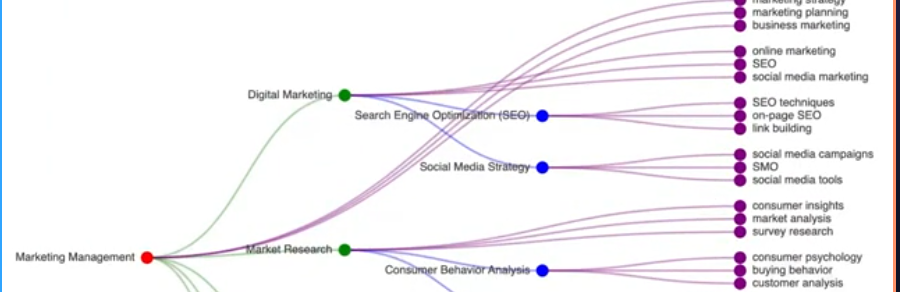
If your site has multiple interrelated articles about a topic, a content cluster, it signals that you have extensive knowledge in that area. A tech blog with an “Ultimate Guide to Machine Learning” plus several related and interlinked posts, like
- “Machine Learning vs. Traditional Programming,”
- “10 Applications of Machine Learning in Marketing ”,
- “Top Strategies for Machine Learning Implementation,” etc.
demonstrates topical authority in ML. Google’s AI is more likely to cite such a site for an ML-related query than a site with just one article on it.
Also, a comprehensive pillar page with in-depth guidance on a subject is a strong candidate for AI Overviews. Especially if it links out to more detailed sub-articles on specific subtopics.
4. Clear Structure and Formatting
A well-structured page makes it much easier for AIO to parse and extract information to build its answer. Using descriptive headings (H2, H3, etc.) that outline the questions or subtopics you’re covering helps both the readers and the AI algorithm to scan and locate where a specific answer might be.
A pro tip from SEO experts is to even phrase some subheadings as questions. For example, a heading like “How does Google AI Overview choose sources?” is explicit and may align with a question someone asked.
Content presented in bulleted lists or tables is very AI-friendly. Bullet points break information into digestible chunks that an AI can easily quote or reassemble. In fact, Google AI Overview often displays answers in bullet form or step-by-step form when appropriate. Similarly, tables when comparing data are easy for AI to interpret.
Plus, short paragraphs, just a few sentences each, and clear, declarative sentences help avoid an answer loaded with unnecessary text or convoluted language. Remember, the AI is essentially scanning your content. A straightforward writing style helps.
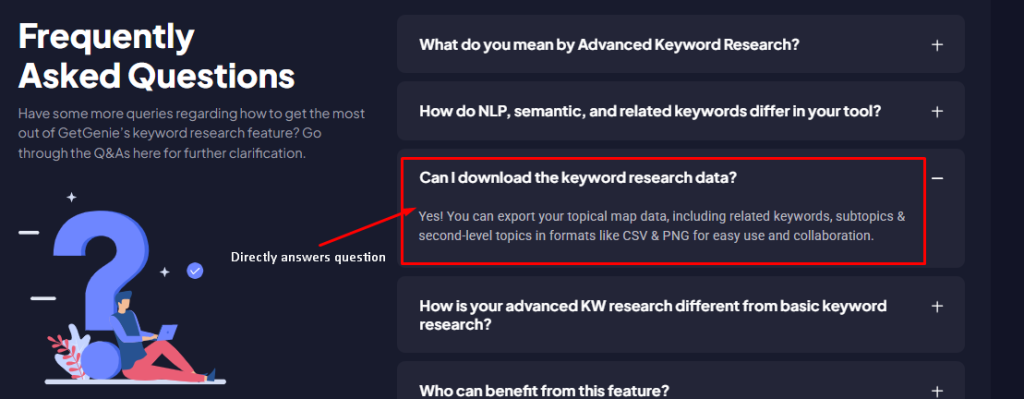
Finally, including an FAQ section on your page boosts your chances of AI visibility. These are naturally structured Q&A pairs, which are perfect for a direct, answer-first approach.
5. Neutral, Helpful Tone
Google’s AI overview does not promote a specific site or product. It answers the user’s query with neutral, factual information. The algorithm is actually tuned to avoid content that seems overly biased or promotional. This has some implications for how you write:
- Avoid Sales Pitch Language: If your content reads like an advertisement, full of superlatives, hype, or “buy now” language, it’s likely the AIO will skip it. The AI doesn’t want to risk presenting a marketing copy as an objective answer.
- Maintain a Factual, Informative Tone: Go for a helpful educator tone rather than a persuading salesperson tone. This doesn’t mean your writing should be dry. It can be friendly and accessible. But it should focus on facts and useful info. Stick to explaining the topic in an even-handed way. If you present pros and cons or multiple perspectives where relevant, even better.
- Think Safety and Accuracy: Avoid content that could be misleading or that Google can’t verify. It has safety checks to avoid hallucinations, grounding everything in cited sources. By writing neutrally and citing reputable facts in your content, you make it easier for the AI to trust and use your material.
- Real-Life Examples Over Hyperbole: Rather than making grand claims (“This is the ultimate solution to X!”), use real examples or case studies to illustrate points. Concrete examples not only improve clarity (which the AI likes) but also reduce the appearance of bias. Interestingly, content that includes real examples and specifics tends to be favored, whereas generic advice might be seen as less valuable.
6. Updated Information
AIO likes fresh content and current information. After all, an AI answer full of outdated info would be bad for users. If your article references something as “recent” but it’s actually from 3-4 years ago, that can hurt. Like mentioning “recent stats from 2019” in 2025 content is a red flag that your info is stale.
Regularly update your content, especially if the topic evolves or new statistics come out. Even just refreshing an article with the latest examples or data points can signal that it’s maintained.
AI Overviews may rotate sources over time, likely to include fresher content when available. Just because one site was cited last month doesn’t mean it will be cited next month if another site publishes something more up-to-date and equally trustworthy.
For evergreen topics (like “how to boil an egg”), freshness isn’t as big a factor. Those answers don’t change much. But for any topic where information can change (technology, SEO, health, finance, etc.), showing a recent date or noting recent developments will help.
7. Site Authority
Google’s AIO can only use your content if it can crawl, index, and interpret it properly. Many of these are classic SEO must-haves. And they’re worth reiterating in the AI context, too.
- Indexability: Your page must be crawlable and indexed by Google to even be considered. If it’s blocked by robots.txt or not indexed, it won’t show up in search or AI results.
- Page Speed: Google usually skips fully indexing a very slow page, and a poor load experience is a negative signal. If pages take too long to load, they might not be fully processed by the AI. Optimize your site performance.
- Mobile Usability: Google uses mobile-first indexing, and many people will view AI answers on mobile. If your page is broken or hard to read on mobile, that’s a quality issue. Problems like tiny text, buttons that don’t work on touch, or horizontal scrolling signal a poor experience.
- Schema and Structured Data: Schema markup is a technical optimization. Implementing the correct schema helps remove ambiguity for the AI. So use the schema carefully and validate it.
How to Optimize for Google AI Overview Selection
By now, the optimization steps might be apparent from the signals above, but let’s consolidate some actionable tips:
- Answer Common Questions Clearly: Identify the questions in your niche (use tools like GetGenie’s Keyword Research or even Google’s “People Also Ask” for ideas) and answer them plainly in your content. Make the answer obvious and early in the text, then elaborate.
- Improve Content Structure: Add headings for subtopics, bullet point lists for key points or steps, and tables for comparisons. Think in terms of bite-sized info pieces that an AI could pick up.
- Use an FAQ: Consider adding an FAQ section addressing likely queries. Properly crafted FAQs target AI Overviews besides the Featured Snippet. Try an AI FAQ Generator for more optimized and better ideas.
- Demonstrate E-E-A-T: Add author bios with credentials, mention your experience, link to reputable external sources, or cite studies. If you have testimonials or case studies, include them. They show real experience. Remove anything that might undermine trust (e.g., factual errors or broken outbound links).
- Tone Down Promotional Language: Review your content for any overly promotional tone. Edit phrasing to be more neutral and helpful. E.g., change “Our product will revolutionize your life!” to “Our product is designed to help with X and Y, based on Z features.” Stick to facts and benefits, not hype.
- Keep Content Updated: Set a schedule to update key pages. Even adding a 2024 statistic in a 2022 article can make a difference. Show a last updated date if possible, as that can signal freshness.
- Monitor and Improve: AI algorithms keep changing. So always check your analytics and GSC data. While Google doesn’t yet label “AI Overview” traffic separately, you might notice certain pages getting more impressions or clicks as they get featured.
Is Optimizing for Google AI Overview Same for an LLM like ChatGPT?
There’s overlap, but also differences. Optimizing for Google’s AI Overview is closely tied to web SEO. Because the AI is pulling real-time web content from Google’s index. It cares about things like schema, site speed, and the latest content on your page.
ChatGPT is a trained model with a knowledge cutoff and limited browsing capabilities. However, the core principles overlap. Both reward clear structure, authoritative info, and comprehensive answers.
If you make your content AI-friendly for Google, you’re also making it easier for any LLM to understand and use your content.
Challenges of Optimizing for AI Overviews
You need to be aware of hurdles when optimizing for AI overviews. The challenges stem from traditional SEO methods and possible confusions from the web algorithms.
- Not keeping it to the point: Your content must answer the question or provide the solution to the problem discussed instantly.
- Following competitors not applying Answer-first approach: Not all content that ranks will sustain in the long-term or even in a few months. So following a high-authority website’s style that does not meet the answer-first approach could hinder your chances of progress.
- Finding the right, updated stats: You might not find the latest or new information on certain stats or data your content provides.
- Low authority site: Your website itself might be of low authority to begin with. So getting your content visible for AI might take more time.
- Deindexed page: If the content or page is not indexed by Google yet, then you are not off the mark anyways. So make sure you have that sorted first.
FAQs
Summing Up
Google AI Overview is shaping up to be a significant part of the search experience. It selects content by looking for the clearest, most trustworthy answers to users’ questions. So our job as content creators and SEO practitioners is to provide exactly that.
By following the cues of the algorithm, which, really, are all about quality, clarity, and credibility, we not only improve our chances of getting featured, but we also create better content for our audience. It’s a win-win.

 Danish
  Swedish
  Polish
  Korean