









10 Social Media Copywriting Best Practices

Effective and powerful social media copywriting turns page visitors into active followers. And possible customers. To ensure effective social media copywriting, you need to understand your audience’s needs, start the writing off well, have a clear objective, keep the copies short, ensure your brand voice, and follow tested frameworks.
Content marketers and content creators globally are competing to attract audiences through social media platforms. But each platform has its own personality and unwritten rules for social media copywriting and content creation. And a one-size-fits-all approach won’t cut it.
Here, you will learn how to plan and customize your writing for different channels. From Instagram’s punchy captions to Quora’s informative answers. And that, too, using proven best practices, tools, and templates.
To write effective social media copies, you must:
➡️ Know your audience and their position with the competitors
➡️ Create the right hook to grab attention
➡️ Write with a clear intent and objective
➡️ Make the best use of copywriting frameworks
➡️ Keep the copies concise and clean
➡️ Ensure you don’t sacrifice the brand voice
➡️ Put the right closing CTAs as per the platform
➡️ Make sure copies completely align with the image
➡️ Use easy-to-understand language
➡️ Track how the posts are performing
Keep in mind that each social platform has its own set of best practices. So write accordingly.
10 Best Practices of Social Media Copies
There are common copywriting principles that apply to all social networks. These 10 practices for social media writing help you make audiences actually want to read, share, and act on.
Knowing your audience & competitors
To appeal to your target audience, you will need to know their taste for language. A fun, emoji-filled tone will suit a lifestyle brand, while a more professional voice fits a B2B company.
You should research how your competitors and industry-leading pages are creating their social copies. And write your copies with a similar voice and tone. For that specific platform.
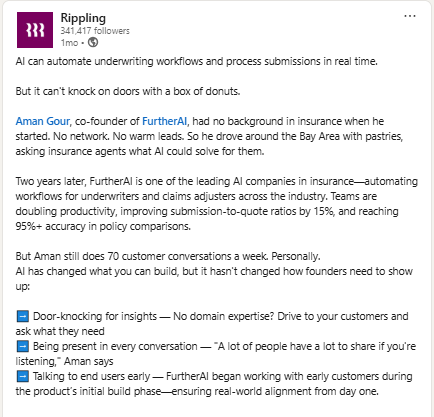
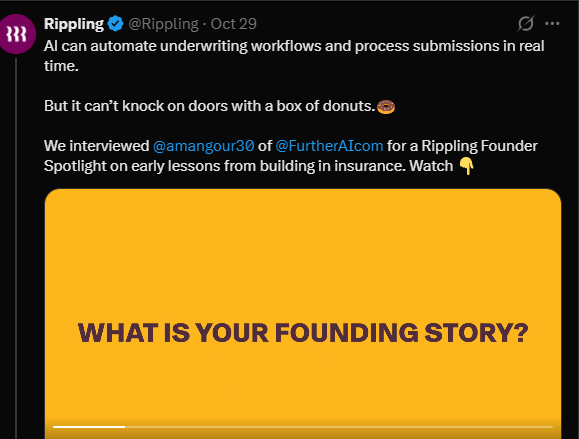
Look at the following LinkedIn and X posts from the HR SaaS brand Rippling. Based on the same topic and content, the copies for the platforms are anything but alike.
X (Twitter)
But in the midst of trying to be platform-specific, do not lose your brand voice. As it represents you and helps you stand out among the competitors for your audience.
Starting with the Right Hook
The first line of your post is make-or-break. Use a hook that stops the scroll. Ask an enthralling question, drop an intriguing stat, or make a bold statement. All these would instantly grab the audience’s attention if it is the right audience.
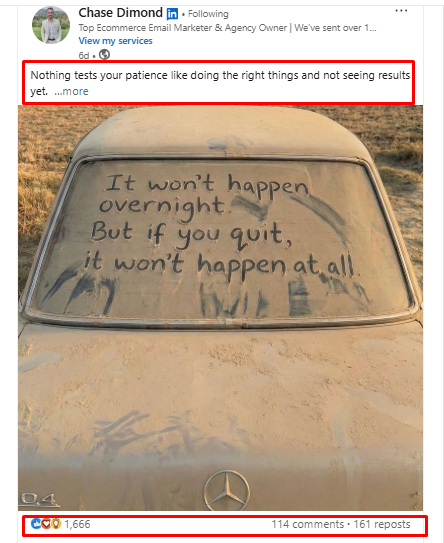
The above statement by a popular digital marketer makes a quick but strong statement within one line to get the hook. And the image with a rusty, old BMW in it, along with the remainder of the post, does the rest. As you can see, the post got over 1600 likes, 100+ comments, and 160 reposts.
Aiming for one clear objective
Your post should either try to spread awareness, promote a brand, make the user take an action, or try to convert leads into customers. Especially when your social media post and copy are for a product, you can easily get lost in channeling the words in the right direction. But for one particular post, you should have one clear objective
Your objective will be reflected primarily through the hook and call to action (CTA). Like the following X post by BambooHR shows the arrival of a new feature. Which they want their target audiences to try.

The CTA at the end takes the user to the desired landing page. To get a demo.
Using Copywriting Frameworks
To work faster and in a more organized style, you should try proven and tested marketing copywriting frameworks. These frameworks offer you a set template, offering a particular flow of writing to get the end results.
A popular framework, AÏDA (Attention, Interest, Desire, Action), intends to make the reader do something. Like purchasing a product by clicking on a link or supporting a cause.
A: Don’t get caught without a business continuity plan.
I: Environmental disruptions are happening more often.
D: Use an easy-to-customize template for quick preps.
A: Get the template NOW.
These frameworks help because you can play with human psychology. These help you with persuasion techniques that work most of the time in sales and promotion.
AI content creation tools like ObtenirGenie offer various copywriting framework templates like AÏDA, PAS, BAB, etc. These offer you different persuasive writing styles, intended to grab attention and stir action.
GetGenie’s Problem-Agitate-Solution (PAS) template helps in creating copies with the framework. When you select the template from the WordPress dashboard, it will slide in from the right. There, you need to enter the name of the product and some description of it.
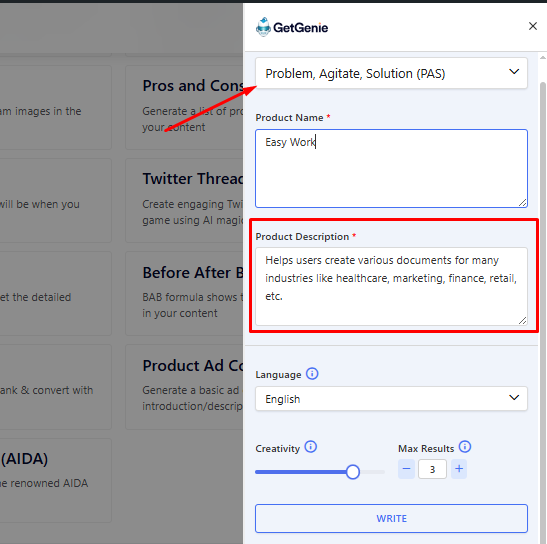
After selecting the language, level of creativity, and number of results, click on Write.
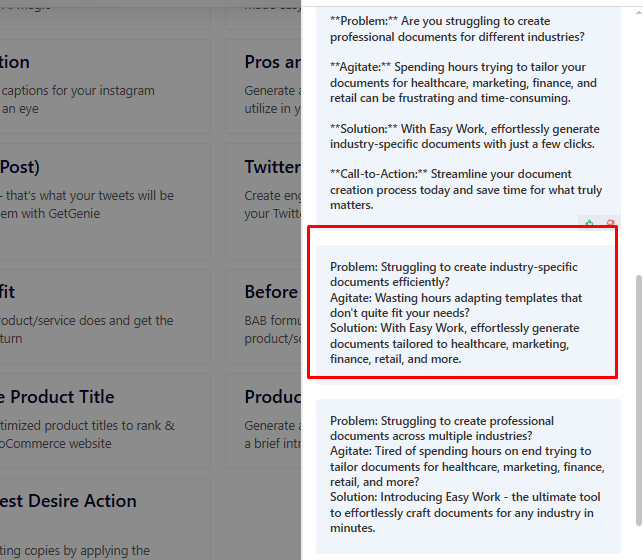
You will receive 3 results. All written in the PAS copywriting framework. Select the one best suited to your needs. Here, I selected the 2nd option, as it’s crispier than the others.
You can repeat the same work with the Before After Bridge (BAB) and AIDA templates.
Keeping it short and clean
Even though platforms like Facebook allow up to 63k characters, studies show that posts around 40–80 characters get 86% more engagement than long-winded ones! Users nowadays have short attention spans. So it’s best to keep the copies below 150 characters and add a strong CTA for further reading.
Using GetGenie, you can create concise yet impactful social copies. The WordPress AI plugin just needs new details like the product name, language, and an optional description. Then it will generate copies, up to 6 results, as per your needs.
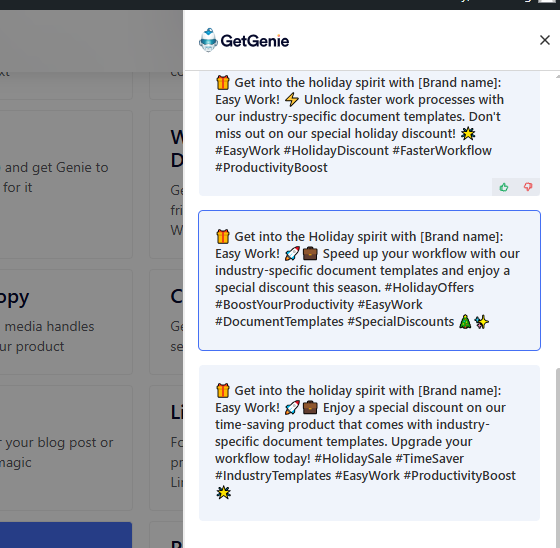
Staying with the same sample product, I’ve generated five social media copies with GetGenie’s Social Media Post/Copy template.
Ensuring brand voice
Maintain a voice that aligns with your brand’s values across all posts. For example, if your messaging is targeted for EdTech firms, keep it formatted and inspiring throughout your posts. Don’t switch between friendly and formal for separate posts.
It is recommended not to do that because your audience will have a certain preference for the tone of voice. And tone consistency gives your copies a personality that connects with the target audience.
You can use AI content tools to help you adjust the tone of the copies. Like selecting the “Tone” of the copy.
Or, do the research yourself to understand your audience’s pain points and preferences. This will let you speak their language and address their needs directly.
Adding platform-specific CTA
An absolute must-have part of your social copy is the CTA! Once your message or story is conveyed in the first few lines, guide the audience toward an action.
However, your CTA should be as per the context and platform. Using a CTA like “Buy Now” would be more suited for an image on Facebook or Instagram. Whereas, “Visit Us” is for more professional social copies on LinkedIn.
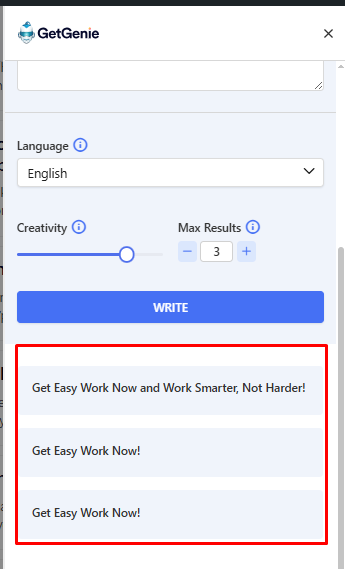
You can also use tools to help you with CTA writing. Here, GetGenie’s CTA template is showing 3 options for the dummy product Easy Work.
Matching caption with visual
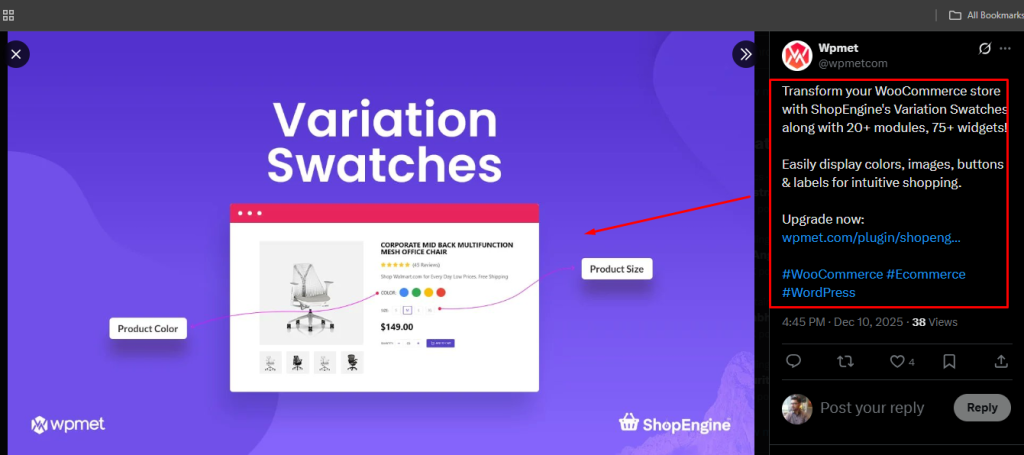
When you write your copies, they must reflect what’s shown on the supporting visual. The social copies can also lead the viewers into reading the message in the image. Or, it can complement the image message by quickly reinforcing what’s communicated there.
A great example of this is the following Wpmet post on X. It’s introducing Moteur de boutique’s variation swatches widget by concisely detailing other benefits of the product.
Making the copies accessible
Keywords and hashtags help your content get discovered. But their usage varies by platform. On Instagram, you can use up to 30 hashtags, but in 2025, the platform itself recommends 3–5 highly relevant hashtags for optimal reach.
X (Twitter)’s algorithm favors at most 1–2 hashtags per tweet. LinkedIn and Facebook hashtags have minimal impact on reach. So use a few niche ones or none at all.
And remember, hashtags are essentially keywords. Think about what keywords your audience might search for, and add those naturally into your copy (especially on Instagram and TikTok, where search is increasingly keyword-driven).
Monitoring and measuring performance
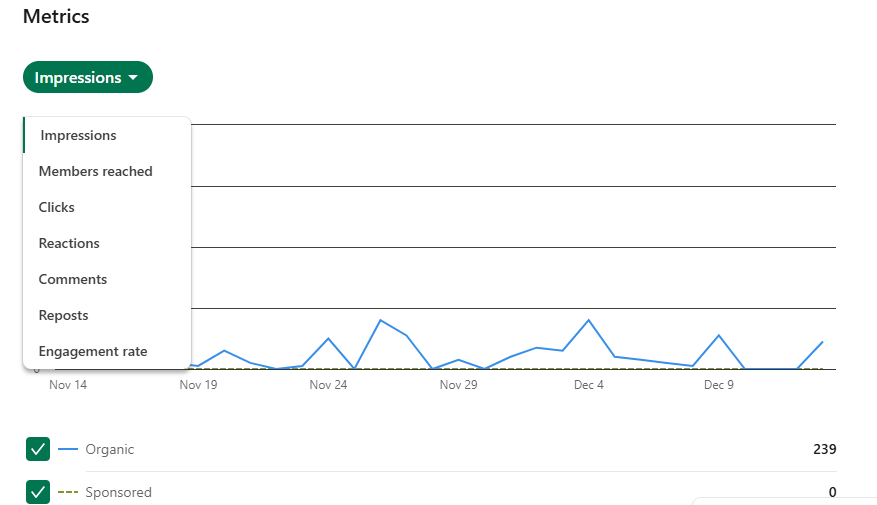
Keep an eye on how your posts are performing. Check which ones get the most likes, shares, comments, or click-throughs, and analyze why. Was it the conversational tone? The question you posed? The time you posted?
The insights from platform analytics will help you improve your social copywriting. You can even try A/B testing copy variations to better your approach.
For example, if your audience responds better when you write with humor, create more content. Treat copywriting as an evolving experiment, and continuously tweak your style and content based on what the analytics and trends show you.
Writing Platform-based Copies?
Let’s now compare and understand how to write social media copies for various platforms, following the best practices.
| Platform | Max Post Length (characters) | Optimal Length for Engagement | Hashtag Use | CTA Style |
|---|---|---|---|---|
| 2,200 characters caption limit | ~125–150 characters or ~1–2 short lines (keep it snappy under 150 characters) | Up to 30 allowed, use ~3–5 niche tags for best reach | Casual tone, emojis welcome; often indirect CTAs like “Link in bio” or direct “Shop now” in caption. | |
| ~3,000 characters on personal/page posts | ~100 characters upfront (LinkedIn truncates around 140 characters), long-form articles (1,500+ words) can work for thought leadership | Hashtags supported but not crucial – 2–5 industry or topic hashtags if relevant | Professional but conversational CTA: e.g. “Join our webinar” or questions inviting comments (to boost discussion). | |
| X (Twitter) | 280 characters per tweet (up to 25k for subscribers) | 70–100 characters (concise tweets see higher engagement) | Use 1–2 hashtags max (Twitter recommends no more than 2) | Direct and urgent CTAs work (“Sign up now ⬇️”), or engagement CTAs (“Retweet if you agree”). Keep it brief and punchy. |
| 63,206 characters (practically no limit) | 40–80 characters (yes, extremely short!) earn more engagement; if longer, ensure the first 80 characters are compelling. | Hashtags have minimal impact; 0–2 hashtags if needed for niche grouping | Friendly, community-oriented CTA: e.g. “Share your thoughts below,” “Click to learn more.” Can include links directly since Facebook posts allow it. | |
| Quora (answers) | No fixed limit (can be long-form) | Aim for 1–4 paragraphs; enough to fully answer the question but lead with a strong, concise summary (~50–100 words) to hook readers. | Hashtags are not used on Quora; focus on using relevant keywords in your answer for search visibility. | Value-first CTA: soft promotion only. E.g. mention a blog or tool as a helpful resource rather than a sales pitch. Often, a subtle “Need more info? [Resource] has it” works better than “Buy now.” |
| Reddit (posts & comments) | ~40,000 characters in a text post; ~10,000 per comment | Varies by subreddit, but shorter posts (a few sentences to a couple paragraphs) tend to get read. Always check subreddit rules. | Hashtags not used; Redditors search by keywords naturally or browse subreddits. Write in plain language with relevant terms. | Community-oriented CTA: ask a question or invite opinions (“Have you tried this? What do you think?”). Avoid overt “marketing” CTAs – authenticity rules. |
If you want to write catchy and trendy social copies via Instagram, GetGenie can help. You will need to either select the Instagram Bio or Modèle de légende Instagram. Let’s pick the Instagram caption template for our purpose.
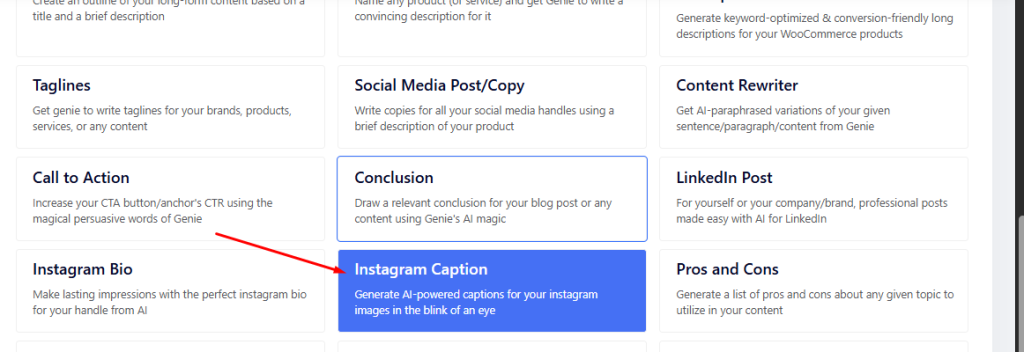
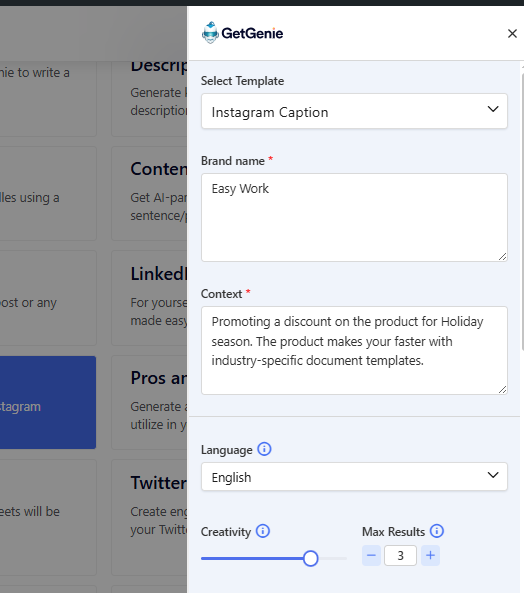
You’ll again need to enter the brand name, Language, number of results, creativity, and a bit of context. And the AI content assistant will generate sample Instagram captions.
Select the one that best meets your needs. And it’s automatically copied for your use.
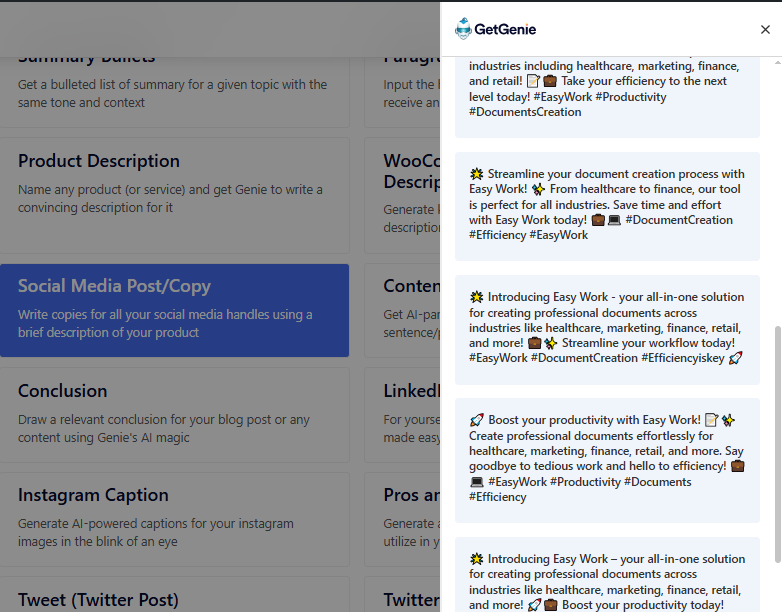
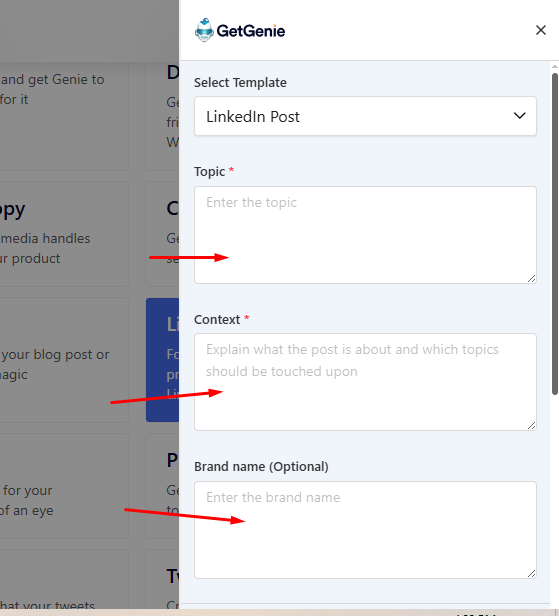
You can also create LinkedIn and Twitter Posts with GetGenie. However, the templates differ in regard to what details they require.
Because LinkedIn is more professional in nature and establishes thought leadership of brands, the template asks for the topic first. And the brand name is kept optional.
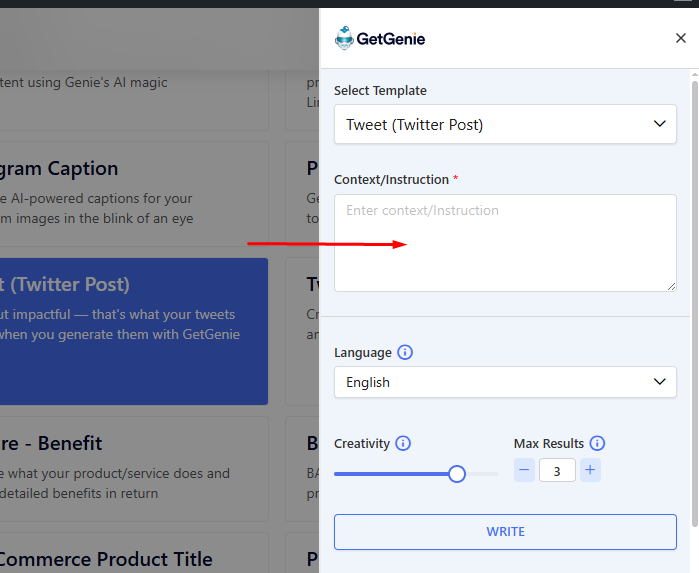
In contrast, the Twitter Tweet template just requires you to enter the context and a few lines of instructions.
How to measure the performance of your social copies
To measure the performance of social copies for business impact or results, you would need to fetch indirect data. The data will come from how the post is performing, rather than the words.
- One way is to A/B test your new copy against existing copies. If nothing else has changed on the page, you can also look at simple before/after performance stats.
- Tracking number of likes and shares
- Monitoring how many people engaged through comments and whether those were positive and negative
- tracking clicks on CTAs to your desired page or content
- Number of views and watch times in case videos and reels
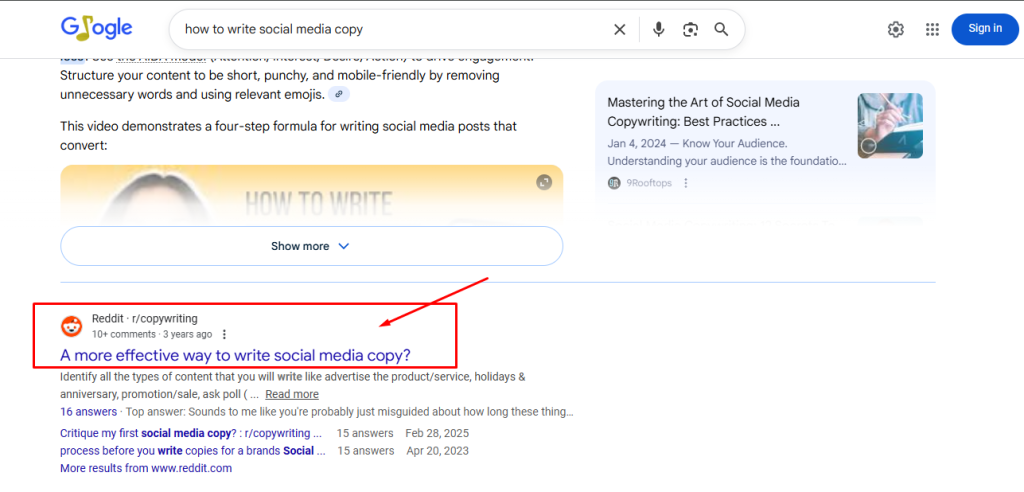
Another way you can try to understand social copy performance is by reverse engineering copy and user searches. You can do that by typing in phrases or keywords from your copies on the social platform search bar. And see the autocomplete suggestions. The same applies to Google Autocomplete, as nowadays authoritative, valuable social posts are making their way to the top of the search ranks.
Common social media copywriting mistakes to avoid
Writing on social media requires careful analysis of the platform and attention to details. Stick to the best practices of social copywriting to avoid mistakes in the first place. Keep in mind the following pitfalls you must avoid:
- Salesy language: Never directly show that you are trying to sell your point or product.
- Grammatical errors: Keep the basics right.
- Ignoring platform styles: You need to understand what types of copies and hashtags work in each platform. One-size-fits-all never worked.
- Keyword Stuffing: As with SEO, a definite NO!
- Use of jargon: This is sort of a crime in content or copywriting. Especially when you write for the audiences.
FAQ
En résumé
Learning social media copywriting best practices and applying those correctly goes a long way in boosting your online presence. The abovementioned strategies are followed by top social media performers and will help you become a prominent brand on your preferred platforms.
Just try to make sure you apply the practices as per the platform. A few basic rules apply to all platforms. But each platform has its own set of best practices, as mentioned above. You can always try AI content creation tools like GetGenie to get help from social media templates. And boost your social presence.

 Danish
  Swedish
  Polish
  Korean