









How to Optimize Content for ChatGPT – Useful Strategies for Better AI Visibility

With so many brands looking for AI visibility and mentions nowadays, you must wonder, “Is there any formula for it?” The answer is, yes, you can influence whether ChatGPT mentions your brand eller cites your content.
But the bad news? You can’t treat your content like traditional SEO-friendly ones. It’s closer to being the most credible, quotable, and consistently referenced entity in your niche.
Let’s learn how.
To optimize content for ChatGPT:
1. Analyze user intent on LLMs
2. Create content that shows topical authority
3. Include FAQs and bullet-points
4. Improve semantic relevance
5. Add social proofs or recognitions
6. Get positive online reviews
7. Ensure brand sentiment
8. Show domain expertise
9. Use structured content
10. Optimize content regularly
Continuously monitor content performance for ChatGPT visibility, avoid LLM visibility pitfalls, and maintain best practices.
What Is Optimizing for ChatGPT?
Optimizing for ChatGPT means improving your chances that ChatGPT will:
- Mention your brand as an option/recommendation (especially for commercial queries), and/or
- Cite your pages as sources when ChatGPT uses web search and shows references.
OpenAI’s “ChatGPT search” experience is explicitly designed to show links to sources via inline citations and a sources panel.
So optimization in ChatGPT is basically visibility of your brand as a top option for searchers. And your pages are linked as references.
Why You Must Optimize Content for ChatGPT?
ChatGPT optimization helps you shift user behavior from searching for multiple posts or sources in the Google SERP to one synthetized answer. Content marketers and SEO professionals benefit from a funnel that ensures:
- Shift user behavior from searching for multiple posts
- Get sources in the Google SERP to one synthetized answer.
- Benefit from a funnel that ensures fewer Google search clicks
- Get brand mentions on AI generated lists
- Instant visibility from LLM platform queries
If you’re not in the shortlist, you’re invisible at the moment of decision. Also, AI answers extract information from credible third-party places like reviews, lists, industry mentions, etc.
Who Does ChatGPT Cite or Mention?
Remember, getting cited by ChatGPT or an LLM is not the same as getting cited by AI Overview. So you need to understand how ChatGPT cites sources and mentions brands.
When ChatGPT cites sources
If your page is
- Crawlable and accessible,
- Clearly answers the query,
- Looks trustworthy
- Has authority
- And only has valuable, useful information,
It has a real shot at becoming a cited source.
When ChatGPT mentions brands
For “best tools / best agencies / best software” type prompts, many GEO practitioners observe that ChatGPT tends to echo signals like:
- Brand mentions across the web
- Reviews and ratings
- Inclusion in authoritative lists
- Overall social sentiment
Neil Patel explicitly highlights brand mentions och reviews as major factors in ChatGPT recommendation behavior. Other key research similarly shows external authority signals and list mentions as strong drivers.
Your off-site SEO and reputation work is now AI visibility work, too.
How to Optimize Content for ChatGPT?
To optimize your content for ChatGPT, you need to apply some important strategies. Like understanding user intent, creating authoritative content, integrating scannable FAQs, ensuring topic depth, getting positive reviews, and more.
1. Understand CHATGPT user search intent
ChatGPT prompts are usually:
- Longer,
- More contextual,
- Based on decision questions.
People want explanations, recommendations, top options, or quick guides. So, target optimizing for questions with constraints. Rather than just for keywords.
Instead of targeting “best WordPress AI plugin,” go for:
- “Best WordPress AI plugin for SMBs in New York”
- “WordPress AI plugin that integrates with MailChimp for email marketing”
- “Top AI Plugin for WordPress Price Comparisons”
2. Create authoritative content
Google’s own guidance for “helpful, reliable, people-first content” is a useful standard here. Because AI systems also gravitate toward content that’s clear, comprehensive, grounded, and genuinely helpful.
“Authoritative” content is more like:
- Original screenshots, examples, templates
- Data supported by methodology (even simple: “we tested X with Y criteria”)
- Clear author bios plus editorial policy
- Sources and references where appropriate
Your content should not read like another AI summary. It will most probably not get cited then.
But in case you want to AI-driven summarized bullet points of a passage, try GetGenie’s Summary bullets template feature! 👉 GetGenie Summary Bullets
3. Integrate useful FAQs
FAQs are perfect for ChatGPT optimization because they:
- Mirror conversational queries
- Offer answers in short, quick structures
- Create clean question-answer blocks
- Expand coverage without bloating the page
Plus, consider FAQ structured data where appropriate. It’s very similar to optimizing for voice search or Google’s “People Also Ask”.
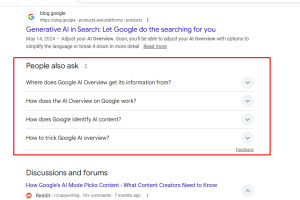
Put your best FAQ answers above the fold on key pages. Not buried at the bottom. Because AI systems prioritize early clarity.
To get help with creating FAQs that AIOs & LLMs love to cite, you can try GetGenie’s AI FAQ Generator. The tool helps you generate AI citable FAQs to help you answer core user questions and boost brand authority.
It works directly in the WordPress dashboard and also as a SaaS product. For WordPress users, you need to just download and install GetGenie to start working with it. Check out the video below to learn how to use it.
4. Improve topic depth or semantic relevance
ChatGPT is not looking for a keyword repeated 27 times. It’s synthesizing meaning.
You need to ensure semantic relevance that helps to build topic clusters and related concept sections. Make sure you use consistent terminology and definitions. For that, add comparison frameworks, including quotable tables
If a user asks about “AI tools for content creation,” ChatGPT will favor content that explicitly talks about “AI tools” and “content creation” in context. So, do your sökordsforskning for natural phrases and synonyms that users associate with.
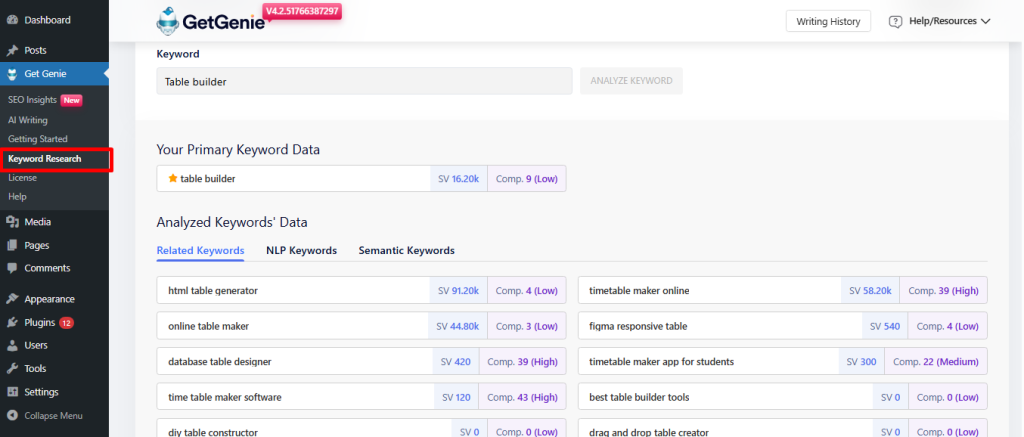
You can get help from GetGenie’s Keyword Research feature, integrated right in the AI & SEO tool. You can access it from the WordPress dashboard by scrolling to GetGenie > Keyword Research.
5. Add recognitions & accreditations
If you have:
- ISO certifications
- Industry memberships
- Security badges (SOC 2, etc.)
- Awards
- Partner badges (e.g., Google Partner)
Put them where they matter. These are the About pages, Pricing pages, High-intent landing pages, Press Release pages, etc.
Why? Because these are machine-readable credibility signals when combined with clear copy and structured data.
6. Get positive online reviews
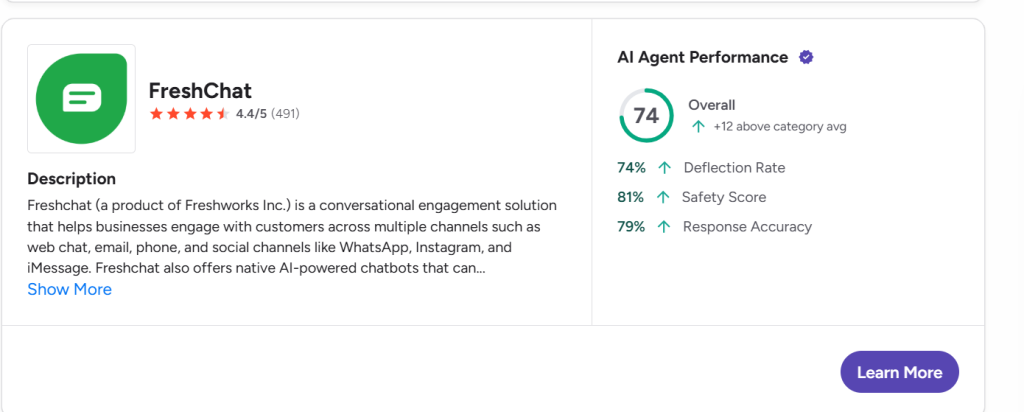
LLMs like ChatGPT prioritize content with positive online vibes and buzz. So, if you want it to recommend you, you need visible proof that real people like you.
What could be some good sources for online reviews?
- Google reviews (local)
- G2 / Capterra (B2B SaaS)
- Trustpilot (broader consumer trust)
- Niche directories in your industry
7. Ensure positive social sentiment (brand conversations)
ChatGPT learns the world through what’s published and repeated.
Its top sources of understanding social sentiments include
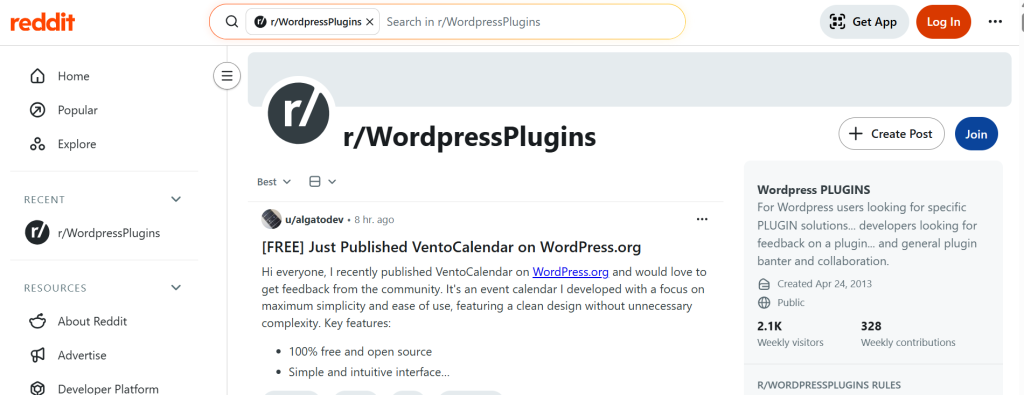
- Reddit threads
- Quora answers
- LinkedIn discussions
- YouTube reviews
- Community forums
Though this factor isn’t as heavily weighted as the others, it does impact when ChatGPT makes close calls. Say, two brands have similar profiles or industry services. The one that’s more popular in online discussions will get the upper hand over ChatGPT in citation and mention.
So, always keep tabs on discussions about your brand on Reddit, Quora, Stack Exchange, Twitter (X), Facebook groups, etc. Are people recommending you? Complaining? Asking questions?
And then engage authentically. Answer questions on forums, address complaints or misinformation, and thank people for positive shout-outs.
8. Show expertise
Google’s Quality Rater Guidelines emphasize Experience, Expertise, Authoritativeness, and Trust as a concept for evaluating quality. Even though ChatGPT isn’t “Google,” the same signals help you look reliable.
- Real author names plus bios
- First-hand experience (what you tested, built, or implemented)
- Clearly defined responsible person for content
- Transparent update dates and revision notes
9. Structure content like you want to be quoted
If you want to get cited, write like you’re making it easy for an AI to extract the best parts. The content should have
- Clear headings and subheadings: Break your content into logical sections with descriptive headings (H2s, H3s, etc.).
- Short definition blocks: Add paragraphs after each heading that signal exactly what that section is about.
- Bulleted lists: These formats are easy for AI to extract
- Numbered steps: Helps detect content with good flow
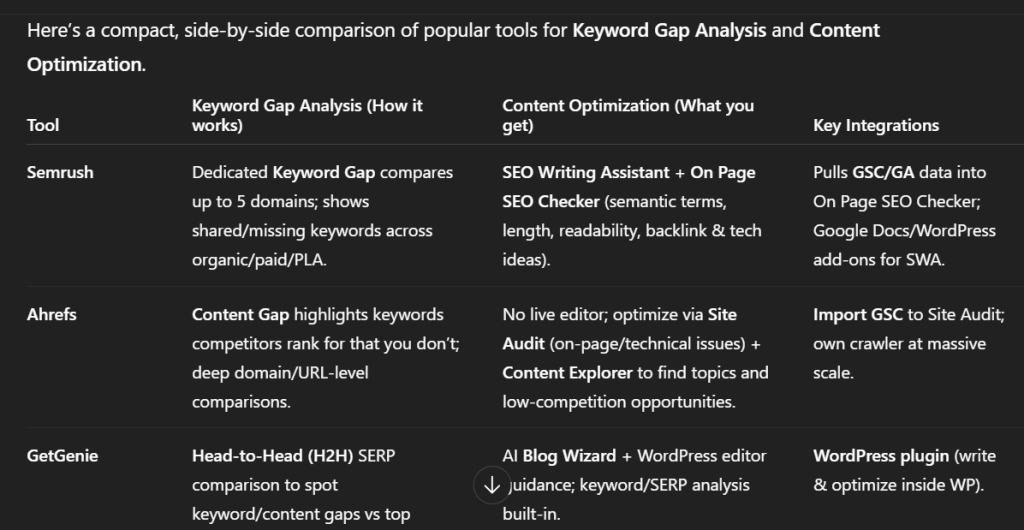
- Comparison tables: Give transactional value that helps users make decisions about brands or products.
- Internal linking and site structure: Maintain a logical site structure where related content is interlinked, and important pages aren’t buried too deep
10. Update content regularly for freshness
AI answers favor content that looks current. So you should update stats and screenshots whenever any change occurs. Besides that, you must add new tools/vendors annually. And keep “best of” lists genuinely maintained with transparent update dates.
Many GEO optimization guides emphasize ongoing updates as a core practice (because the AI-visible landscape changes fast).
How to Measure AI Visibility
You can keep your eye on ChatGPT and look for how your brand is getting mentioned or cited. Or, use tools like Semrush to get insightful data.
Referral & assisted conversion tracking
When ChatGPT sends traffic, it may show up as referral traffic in analytics. Check your analytics for any unusual referral traffic. Some tools and analytics setups can track referrals from “chat.openai.com”, which could indicate users clicking through from ChatGPT’s citations.
Use:
- dedicated landing pages for AI traffic
- UTMs in campaigns you expect to be shared
- “How did you hear about us?” field including “ChatGPT.”
Brand mention monitoring beyond your site
Another thing you can do is track reviews and ratings across the web. This includes user review articles, appearances in “best tools” lists, as well as discussion volume on Reddit/LinkedIn.
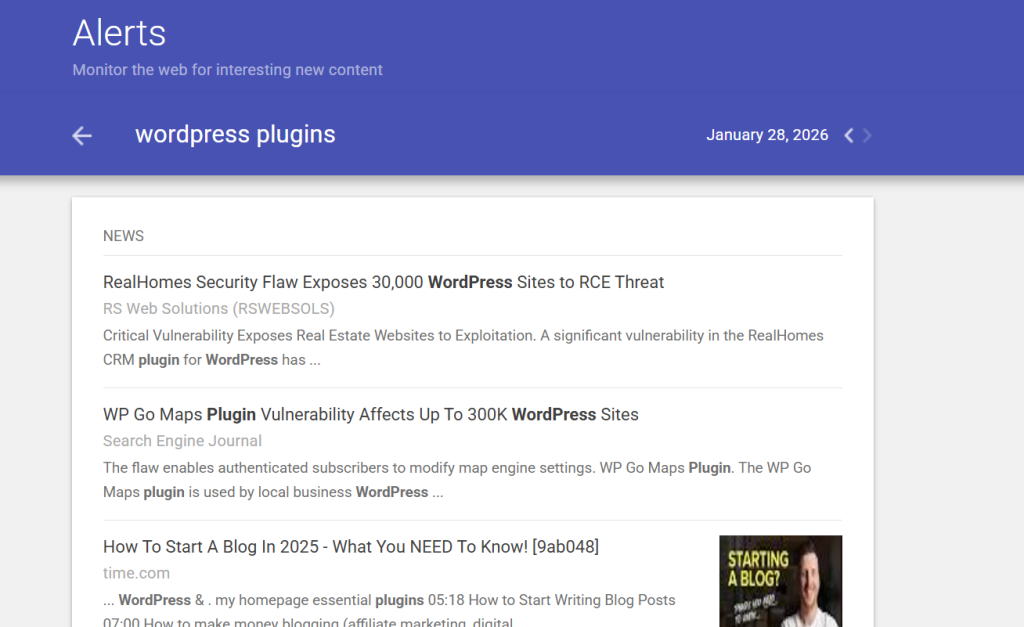
Use Google Alerts or mention-tracking tools for your brand name and key product names. More mentions could correlate with more AI awareness of your brand.
Quality of traffic and leads
You can also measure success by the quality of interactions. If ChatGPT is recommending you well, customers coming via that route might be highly qualified. Because they asked for “the best X” and got you. So monitor if you’re seeing higher conversion rates or engagement from users who mention AI.
Common Pitfalls to Avoid
When planning, creating, and updating content for ChatGPT optimization, avoid these pitfalls. And help yourself optimize content better for ChatGPT.
- Thinking this is only on-page SEO: If nobody mentions you anywhere reputable, you’ll struggle to be recommended.
- Expecting Direct Traffic: Many ChatGPT answers result in zero clicks. So don’t expect tons of direct traffic to your site.
- Publishing “AI fluff” content: Generic content that adds no new value is less likely to be cited and less likely to build trust. “People-first” standards still matter.
- No proof signals: No authors, references, reviews, or case studies means no credibility.
- Ignoring structure: Loads of text don’t get quoted. Structured content does.
- Trying to “game” it with spam: Low-quality mentions and fabricated reviews can backfire and damage reputation long-term.
Vanliga frågor
Sammanfattning
Optimizing for ChatGPT requires clear, structured content. The content also needs to be trusted and valuable. To gain trust, you need reviews, lists, and brand signals. Also, social sentiment plays a key role in ChatGPT mentions.
Make sure you do all these and more as mentioned above. And you’ll increase your odds of being both cited and recommended by AI-assisted search.

 Danish
  Polish
  Korean