







Topical Authority vs. Keyword Density: What Matters the Most?

Modern SEO strategies have undergone significant changes over the years. You can notice changes in how search engines interpret and rank content. Two concepts that often come up in these discussions are topical authority and keyword density. While both aim to improve search visibility, they approach the problem from different angles.
In this article, we’ll break down topical authority vs. keyword density and explain how these approaches differ. We’ll also present a clearer picture of how modern search engines evaluate content.
Let’s dive into the details of topical authority vs. keyword density.
- Defining Topical Authority & Keyword Density
- Topical Authority vs. Keyword Density: The Role in SEO, AEO & GEO
- Which is Most Relevant in 2025?
- Why the Shift Away from Keywords Happened?
- Targeting Real KPI vs. Visibility Metrics
- Q1. What is keyword density?
- Q2. What is topical authority?
- Q3. What is the difference between topical authority and keyword density?
- Q4. How can I build topical authority for my website?
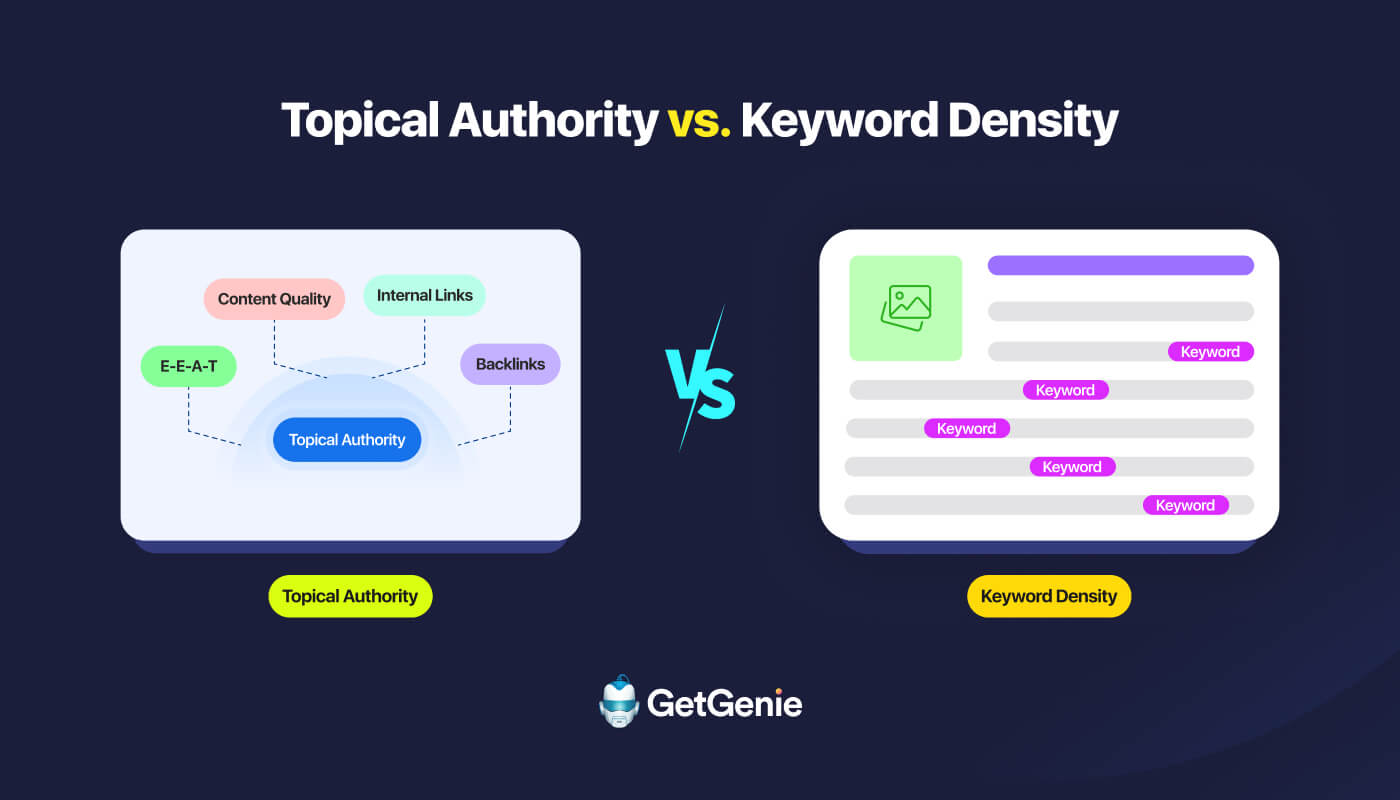
Modern SEO evaluates how well content satisfies user intent. Topical authority and keyword density take different approaches to improve search visibility.
Topical Authority
Focuses on covering a subject comprehensively, including related subtopics, questions, and supporting concepts.
Demonstrates expertise and trust by showing a deep understanding of an entire topic.
Aligns with how modern search engines evaluate content for complex and informational searches.
Prioritizes depth, relevance, and user value over exact keyword repetition.
Keyword Density
Refers to how often a specific keyword appears within a piece of content.
Historically used as a ranking factor to signal relevance to search engines.
Remains useful for context and clarity when applied naturally.
Serves as a supporting element rather than the primary driver of rankings in today’s SEO landscape.
Defining Topical Authority & Keyword Density
Keyword density means how many times a specific word or phrase appears in a piece of content compared to the total number of words. For example, we’re wearing a bright neon shirt at a party so people notice you’re there. It proves you are present, but it doesn’t prove you belong.
The concept of topical authority is owning every sub-topic, question, and nuance related to a subject. It’s like you’re the person at the party who actually has the best stories, and everyone is around you. So this way, when you’re building authority for your site, you’re owning an entire concept by answering every related question and covering every nuance. That means you aren’t just visiting the topic; you own the neighborhood.
Topical Authority vs. Keyword Density
Let’s check out the differences now.
Topical Authority vs. Keyword Density: The Role in SEO, AEO & GEO
Along with SEO (Search Engine Optimization), Google also considers other factors when ranking content in search results.
AEO (Answer Engine Optimization): Ensures your content answers user questions clearly and accurately.
GEO (Google Experience Optimization): Evaluates the overall quality, usability, and user experience of your content.
Let’s see the roles of keyword density and topical authority in SEO, AEO, and GEO.
| 측면 | Keyword Density | Topical Authority |
|---|---|---|
| Primary Unit | Focusing on a primary search term to match a user’s exact query and stuffing it in the content. | A collection of interlinked topics. |
| The Goal | To be found for a specific word. | To be trusted for an entire subject. |
| SEO Role | 그것 shows relevancy and confirms the page is about a specific query. | 그것 confirms your site is an expert on the subject and helps to build trust. |
| AEO Role | Assists in signaling the main topic, but does not guarantee precise answers. | Helps provide complete, accurate answers to user questions. |
| GEO Role | Contributes minimally; excessive keyword use can harm 사용자 경험. | Improves overall content quality and user trust through depth and clarity. |
| Google’s View | A ‘Check-box’ factor; essential but not a competitive edge. | A ‘Core’ factor determines ranking for entire clusters. |
Which is Most Relevant in 2025?
Topical authority is the most relevant factor in 2025. Google’s AI Gemini and specialized algorithms now favor ‘Subject Matter Experts’. A site that covers a topic in depth, answers every how, why, and what if, will consistently outrank a page that simply repeats a phrase.
On the other hand, keyword density is only relevant as a safety check. Its job is to make sure you didn’t miss mentioning the actual topic or the users’ query. But it has less power today to actually push you to the top of the search results.
| SEO approach | In 2020 | In 2025 |
|---|---|---|
| Using exact keywords | Could boost a page | Little to no boost |
| Keyword stuffing | Somewhat useful | Disliked by search engines |
| Detailed content | Becoming noticeable | Essential for ranking |
| Neat content layout | Helped readability | Expected by search engines |
So in 2025, you can consider the topical authority as the leader, 그리고 keyword density as the assistant.
Why the Shift Away from Keywords Happened?
So you already know that search engines no longer rely on counting words. They now focus on understanding what a page actually explains and how helpful it is for users.
The Technology Leap
- Google as a String Matcher: There was a keyword-first era; Google was a String Matcher then. It looked for strings of letters like ‘baking tips’. If your page had that string the most, you won.
- New Knowledge Graph: Today, with the introduction of the Knowledge Graph, Google has become a Concept Mapper. It now understands that the keyword ‘baking tips’ is inherently connected to entities like yeast, gluten, oven temperature, and kneading. If you don’t mention these related concepts, Google assumes you aren’t actually an expert, regardless of how many times you repeat the primary keyword.
The Intelligence Leap
In the early days, search engines struggled with the nuance of language and context. The arrival of technologies like 버트 그리고 LLMs like Gemini allowed Google to read a page almost like a human. They can also detect Semantic Depth now. These models can easily distinguish between a ‘content farm’ repeating words for a bot and a ‘thought leader’ and add unique value.
So, Google now prioritizes the underlying user intent. It looks for the meaning behind the search, rather than the exact characters typed into the search bar.
The Trust Leap: E-E-A-T
Google realized that keyword repetition was a cheap signal that anyone could manipulate. To ensure quality, they have introduced a mix of factors, known as E-E-A-T – Experience, Expertise, Authoritativeness, and Trustworthiness.
E-E-A-T led to the 유용한 콘텐츠 업데이트, which penalize search-engine-first content that lacks depth. Topical Authority is an expensive signal; it requires time, logical internal linking, and a comprehensive content library. Because it is much harder to fake than keyword density. It has become Google’s primary way to verify a source’s credibility, identify people-first content, and reward them.
Informative for you: Get to know E-E-A-T and the quality rater guidelines
Targeting Real KPI vs. Visibility Metrics
Keyword density often boosts visibility metrics or popularity numbers. Like impressions or keyword rankings, but these numbers don’t always mean real results. A page can rank for many terms yet fail to keep readers engaged or convert them.
하지만, topical authority focuses on real KPIs. When your content covers a topic fully and answers user questions, it improves time on page, return visits, and conversions. Thus, you target key performance indicators (KPI). Search engines reward this depth because it signals usefulness, not just keyword placement.
Should You Stop Keyword Research for Your Content?
No. Keywords still help you understand what your audience is searching for and guide your content topics. The difference now is how you use them. Follow these quick tips:
- Focus on naturally including keywords
- Cover the topic fully instead of repeating words
- Use related terms and phrases to show context
- Answer real questions your target audience has
- Create a content outline clearly with headings and sections
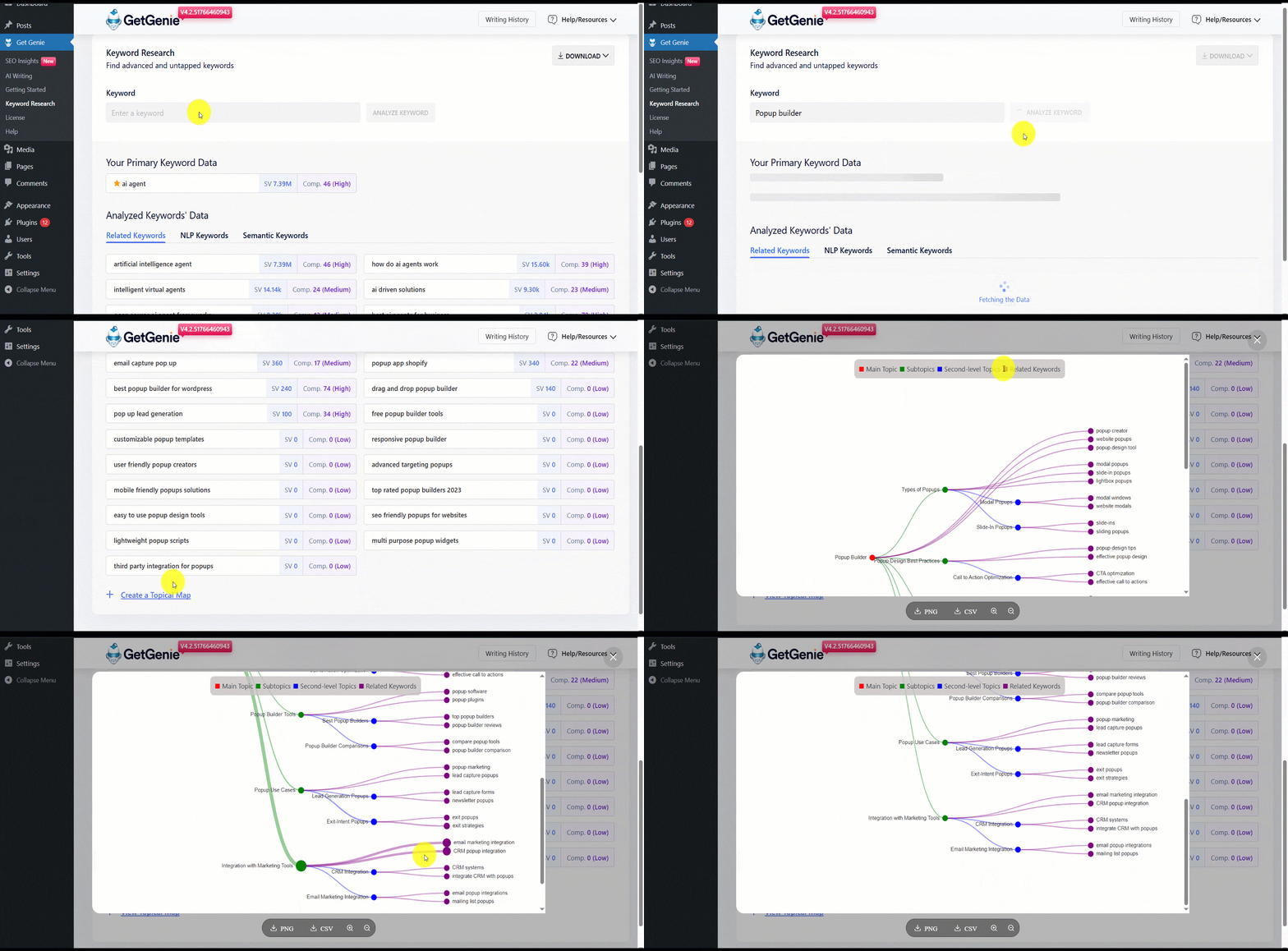
However, to make your tasks easier, consider using tools like GetGenie’s Advanced Keyword Research to find related, NLP, and semantic keywords and build a topical map that shows how topics connect
Finding Your Keyword Density and Building Topical Authority
Keyword Density: You can calculate keyword density easily –
Keyword Density = ( Keyword Count/ Total Word Count) * 100
If you mention a term like ‘Digital marketing’ 10 times within a 1,000-word post, your concentration is 1%.
However, to find the right keyword for your content in less time and effort, you can take advantage of GetGenie’s Keyword Research feature. It quickly analyzes Search Volume (SV) 그리고 경쟁. It generates a comprehensive list of Related, NLP, and Semantic keywords.
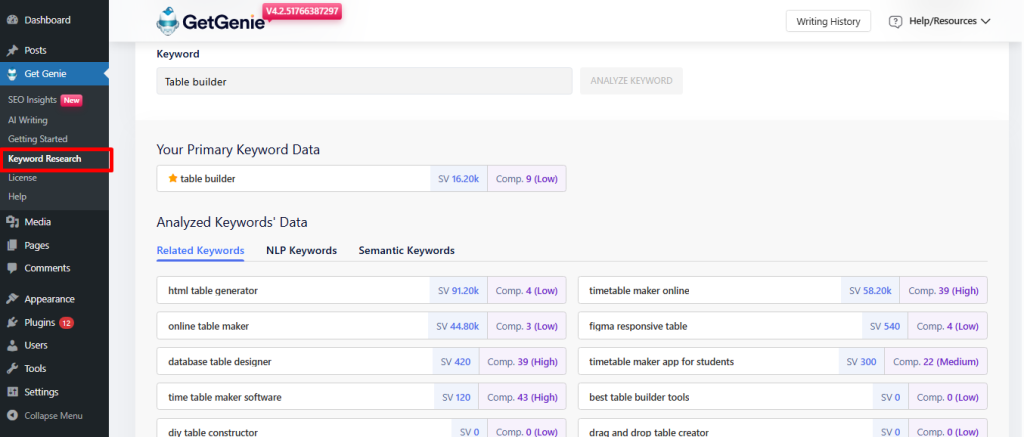
Topical Authority: You can build topical authority for your website by publishing multiple, well-linked pieces that cover one subject fully, not just one keyword. You have to update content regularly, answer real user questions, and support it with a clear structure and internal links.
Make topical authority for your website with GetGenie AI. The list of Related, NLP, and Semantic keywords helps you build deep topical authority effortlessly.
자주 묻는 질문
Q1. What is keyword density?
Keyword density measures how often a specific word or phrase appears in a piece of content compared to the total number of words. It helps indicate what a page is about, but is now mainly a supporting signal in SEO.
Q2. What is topical authority?
Topical authority is the depth of coverage a website or page has on a subject. It shows expertise by addressing all related subtopics, questions, and nuances. Thus, it helps search engines recognize the site as a trusted source.
Q3. What is the difference between topical authority and keyword density?
Topical authority aims to cover an entire subject in depth, including related subtopics and questions. Keyword density measures how often a specific keyword appears in your content.
Topical authority signals expertise, whereas keyword density signals basic relevance.
Q4. How can I build topical authority for my website?
Publish multiple, well-linked articles that cover a subject fully, answer real user questions, update content regularly, and use related terms and semantic keywords to show depth.
주요 시사점
The differences and importances are clear now. To succeed in modern search, here are some tips for you:
- Use keyword density to signal what your page is about, but don’t rely on it alone.
- Focus on building topical authority by covering related subtopics, questions, and concepts.
- Write for understanding and usefulness, not just keyword placement.
- Remember that search engines reward trust over time, and topical authority is what leads to stable rankings and real results.

 Danish
  Swedish
  Polish