









How to Do SERP Analysis to Outperform Competitors


When I first started writing SEO-friendly blog posts, my optimization approach was simple. Find keywords with tools like Ahrefs, SEMrush, or Ubersuggest and pick ones with good search volume and low-to-medium difficulty.
Lately, this approach alone wasn’t working for me. Many of my recent posts struggled to rank on Google. This failure led me to explore alternative methods to rank higher in the SERP. I started analyzing the SERP 페이지 already ranking there for my target keywords.
I discovered that these pages were targeting more specific keywords, unlike the keyword research tools. In this write-up, I will show you how to do SERP analysis effectively for your SERP content (blog posts & landing pages) based on my experience. So, read on…
SERP analysis will help you understand why certain pages rank for a keyword and what type of content search engines prefer for that topic. Once you examine the existing results before writing, you can build content that aligns with both user intent and ranking patterns.
Apply the following steps to do SERP analysis:
1. Identify the target keyword related to your niche or business topic
2. Understand the search intent behind that keyword
3. Analyze the top-ranking competitors for structure, topics, and content format
4. Extract useful insights and content gaps from competitor pages
5. Create more comprehensive content based on those insights
6. Monitor SERPs regularly to track performance and changes
Suppose you plan to write about “WooCommerce SEO Best Practices.” By analyzing the SERPs, you may notice that most ranking pages cover product title optimization, image SEO, schema markup, and internal linking. This gives you a clear direction on how to structure and improve your content.
SERP analysis helps you move beyond guesswork and create content that has a stronger chance of ranking in search results.
How to Do SERP Analysis
To do SERP analysis, you have to analyze the highest-ranking pages for your target keyword and identify common ranking factors. With these insights, you can create more comprehensive and intent-focused content for Google.
The following 5 steps will help you do SERP analysis regardless of your niche.
1. Identify the Target Keyword
Your first step of SERP analysis is identifying the right target keyword for your content. This usually begins with your seed keywords. That means you have to find the basic terms related to your business or niche.
For example, if you run a WooCommerce store or provide WooCommerce services, your seed keywords typically will be:
- WooCommerce store
- 우커머스 SEO
- WooCommerce product pages
- WooCommerce speed optimization
To write content (blog posts) on these seed keywords, you have to expand them. And this is something you can do by brainstorming.
또한, Google Autocomplete, 사람들은 또한 묻습니다, 그리고 People Also Search For sections in the SERP can help. These areas will uncover what users frequently search for around your topic.
For instance, if you type “WooCommerce SEO”, the following suggestions are likely to show up in the above features:
- WooCommerce SEO tips
- WooCommerce SEO plugin
- WooCommerce product SEO
These variations will often reveal long-tail keywords with clearer intent.
To go deeper, you can use various keyword research tools. If you use GetGenie’s keyword research, it will help you find NLP keywords, semantic keywords, and related keywords connected to your target topic.
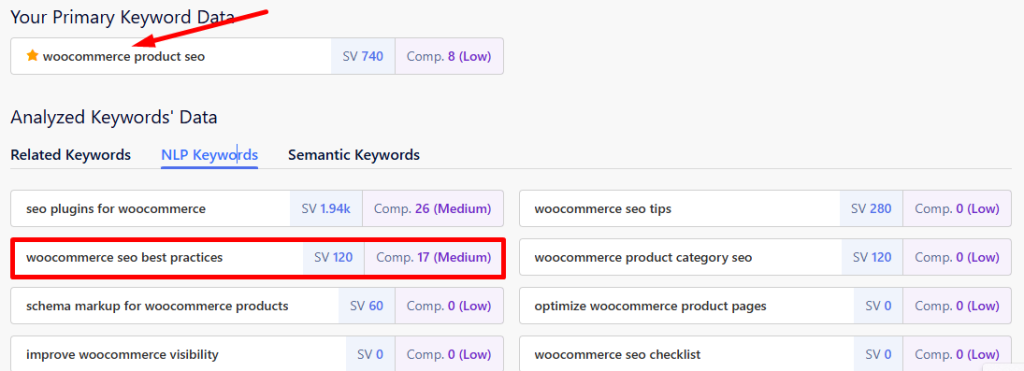
GetGenie will bring both short-tail (broad) and long-tail keywords (specific) to the table. It’s your job to analyze their potential from the given data and select the one(s) to write on.
When you adopt both manual and AI-powered approaches, the target keyword(s) you will choose are likely to be topically relevant, rankworthy, and traffic drivers.
2. Figure Out the Search Intent
Once you have your target keyword, find out why people are searching for it (검색 의도). What info they want to know by typing the keyword in the search bar?
Search intent usually falls into 4 categories:
- Informational
- Navigational
- Transactional
- Commercial
You can identify user intent by analyzing existing results on Google for the keyword. SEO tools like SEMrush will also show intent indicators for your focus keyword.
If your focus keyword is “WooCommerce SEO Best Practices”, it’s likely to be an informational keyword. So, writing a blog post on this long-tail keyword is a perfect fit.
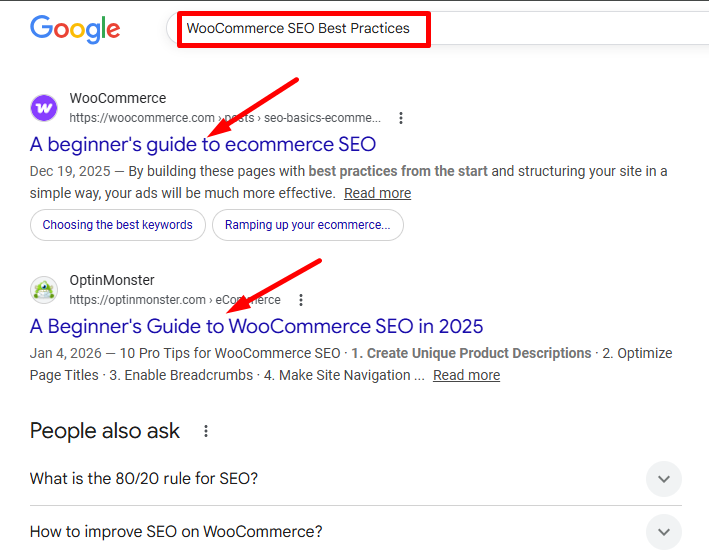
However, if you choose a short-tail keyword, the search intent is likely to be commercial or navigational.
예를 들어, for the keyword “WooCommerce Themes”, Google shows commercial intent in the first 3 results. It’s because users want theme lists or marketplaces for this keyword, not detailed guides.
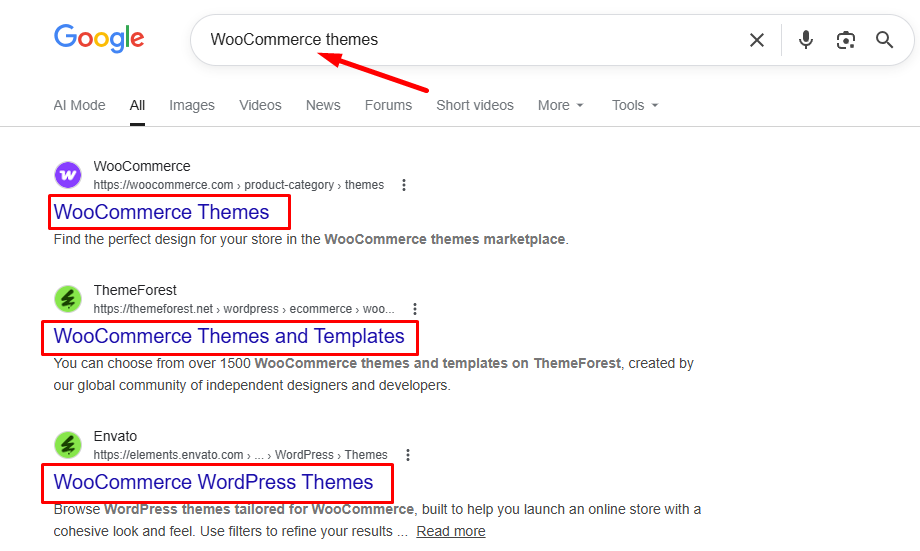
Bear in mind, if your content doesn’t match the intent, even well-written content will struggle to rank. That’s why understanding search intent is critical before analyzing the SERPs.
Analyze the Competitors for Your Target Keyword
In this step, you have to examine the pages that already rank for your target keyword.
Search your keyword on Google and carefully analyze the top results. Look for patterns such as:
- What points did competitors cover
- Their content angle or approach
- Headings and subtopics
- Content length
- Content format (guide, listicle, tutorial, etc.)
For the target keyword “WooCommerce SEO Best Practices”, most top-ranking articles will include sections about:
- Keyword research & mapping
- Product title & description optimization
- Product image optimization
- Schema markup use
- Internal linking & user-generated content, and more
If you want to get your competitors’ content info in one place, use tools like GetGenie. The AI SEO writing tool will show you competitors’ content for your focus keyword clearly.
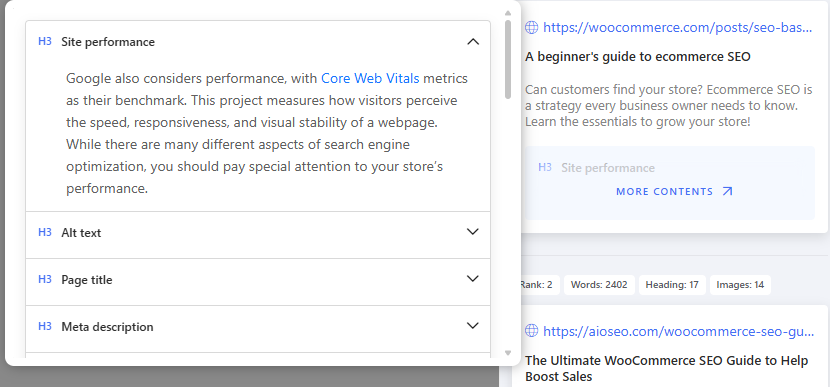
Also, find headings, keywords, and content structures of your competitors efficiently.
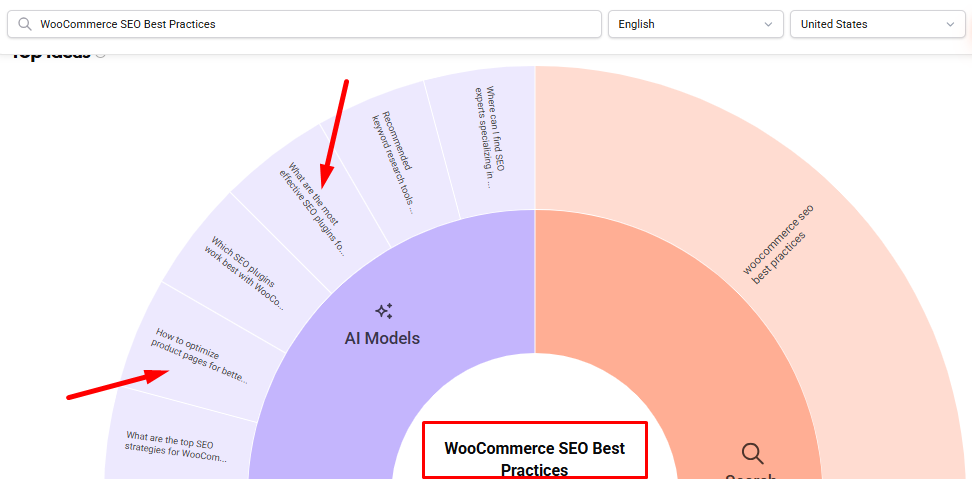
GetGenie SERP Analysis at a Glance:
Avail the Useful Data from Competitors
After analyzing competitors, the goal is not to copy them but 에게 extract useful insights and improve upon them.
Suppose your competitors briefly mentioned WooCommerce product image optimization as a tip for the above target keyword.
In your write-up, you can create a more detailed but relevant section covering compression tools, alt text strategies, and file naming conventions.
Use tools like 답변ThePublic to discover additional questions people ask about your topic. These questions will help you add unique sections that will make your content more comprehensive and useful than competing pages.
Monitor SERPs Regularly
SERP analysis doesn’t end after publishing your content. Search results constantly change as competitors update their pages or new content appears.
That’s why it’s important to track SERPs regularly for your target keyword.
Keep track of things like:
- Which websites rank above or below you
- Changes in content format (guides, videos, listicles)
- Competitors updating or expanding their content
- Competitors’ engagement, like monthly traffic and backlinks
다음과 같은 SEO 도구 SEMrush or Ubersuggest can help you analyze competitors’ traffic, backlinks, and other performance metrics.
You should also monitor your own performance through Google Search Console, where you can track:
- Keyword position
- 클릭
- 인상
- Click-through rate (CTR)
When you continuously track all these metrics, you will automatically understand what to do to enhance your content and outrank competitors in the SERPs.
Turn SERP Insights into Ranking Opportunities
SERP analysis is mainly a reality check before creating content. Keyword tools can suggest tons of ideas, but the search results show what actually matters. It unveils the level of competition, the type of content dominating the results, and whether your site has a chance to compete.
Once you have the real SERP data for your target keyword, you can go ahead to craft your content with unique insights and outrank your competitors in no time.

 Danish
  Swedish
  Polish