








7 Common Mistakes that Make Content Invisible to AI Search

If your content isn’t appearing in AI-generated answers or summaries, it’s not because it’s bad. You’re just invisible to AI.
AI-powered search is changing how content is discovered, ranked, and summarized. Tools like Google’s AI Overviews, ChatGPT, Perplexity, etc., don’t simply scan for keywords. They interpret context, structure, trust, and usefulness of the content.
However, many content creators unintentionally fail to address the core question and focus on key information. Most of the time, they focus on creating content that is too vague and without considering the proper formatting. These mistakes are the common reasons why they became invisible to AI.
This guide will tell you what those mistakes are and how you can work on them to become visible in AI search results.
Quick Overview: Mistakes that Make Content Invisible to AI Search
Content becomes invisible to AI search when it fails to deliver clear, structured, and trustworthy information that AI systems can easily extract, understand, and cite.
7 Common Mistakes that Make Content Invisible to AI Search:
1. Mistaking AI search for traditional search engines.
2. Content not structured for machine understanding.
3. Prioritizing keywords instead of conversation.
4. No established enough trust signals (E-E-A-T).
5. Inconsistent or unclear brand messaging.
6. Poor user experience signals.
7. Ignoring technical SEO.
Esempio
A company’s product guide is buried in long paragraphs with no schema or clear headings. AI assistants don’t show it in answers. After adding direct answers at the top, FAQ schema, and author info, AI begins recommending it.
Riepilogo
AI search visibility is less about traditional SEO tricks and more about clarity, structure, and trust. If your content is easy for machines to read, verify, and quote, it becomes visible. If not, it becomes invisible.
Understanding AI Search
What Is AI Search?
AI search refers to search experiences powered by large language models (LLMs) and machine learning systems. These LLMs and machine learning systems interpret user intent, synthesize information, E generate direct answers rather than simply listing links.
Instead of asking:
“Which page has the keyword?"
AI asks:
“Which content best explains, supports, and answers this question?"
The AI search system does:
- Summarize information across sources
- Favor clarity and topical authority
- Pull answers from structured, trustworthy content
How AI Indexes and Interprets Content
AI doesn’t read content like humans. When an AI indexes an article, it usually performs these steps:
- Scans the article structure like title, headings, paragraphs, and bullet points.
- Then AI identifies key terms and related terms or phrases within an article.
- AI does not treat these terms and phrases as fragmented keywords. It stores them along with their context.
- And finally, it links the article to other related topics.
That is why AI can quickly retrieve information or an article when someone is searching for a certain topic.
But when it comes to interpreting content, AI actually does these steps:
- AI uses semantic analysis to understand the context.
- It then recognizes the relationships between concepts, synonyms, and related ideas.
- AI determines the main intent of an article.
When a user asks AI about a certain query, AI provides an answer by extracting the indexed concepts that match the query. Rather than copying word for word from the indexed concepts, AI retrieves information from the indexed articles and summarizes relevant insights.
Why Content Can Become Invisible
Your content may be invisible to AI search for several reasons. And this includes:
- Lacks clear structure and hierarchy
- Doesn’t answer questions directly
- Has a weak or unclear topical focus
- Fails to demonstrate expertise or trust
- Is technically difficult to crawl or interpret
Mistakes That Make Content Invisible to AI Search
Well-written content doesn’t mean perfect to be visible in AI search. They still become invisible because we tend to ignore what AI actually wants.
1. Mistaking AI Search for Traditional Search Engines
As we write an article, we optimize for ranking because we thought that the ranking is what the AI prefers.
But there’s a great difference between SEO and AI search. SEO focuses on links, keywords, and SERP positions. On the other hand, AI search focuses on answer quality and contextual relevance.
Here are the common issues when we write content:
- Content written purely for keyword placement
- Overuse of SEO templates with little originality
- Pages designed to rank, not to explain
When our article is written for SEO, AI will not index it. AI models look for explanations, definitions, and clear answers that directly respond to a query.
2. Content Not Structured for Machine Understanding
We write an article based on what humans need only, but we forget the machines. Yes, we satisfy humans, but AI systems rely on structure to identify what a page is about and how information is related.
Here are the common issues with our content why machine could not index our content:
- Missing or inconsistent H2, H3, H4 headings
- Long paragraphs without scannable elements
- No summaries, tables, or lists
With these issues present in our content, it became poorly structured. It’s difficult for AI to extract precise answers.
3. Prioritizing Keywords Instead of Conversation
Prioritizing keywords instead of conversation is an outdated SEO practice. AI search mirrors how people speak and ask questions.
An article that is stuffed with keywords often sounds unnatural and fails to match conversational intent.
These are the common practices when writing an article that conversation becomes out of the picture:
- Awkward keyword repetition
- Ignoring long-tail and question-based phrasing
- Writing for bots instead of people
These practices can make our article awkward and meaningless. Instead of AI indexing our article, it skips. AI prefers content that flows naturally and answers questions clearly.
4. No Established Enough Trust Signals (E-E-A-T)
A low trust signal is an indicator of a lack of credibility. AI tools prioritize content that is trustworthy. This means that an article that demonstrates expertise, credibility, and freshness is picked by AI systems for AI-generated summaries.
Here are the common reasons why an article has poor trust signals:
- Missing author bios or credentials
- Outdated content with obsolete data or broken links
- Lack of depth that supports the topics
- Lack of external citations or references
- No evidence of firsthand experience
- Generic or AI-generated content with no originality
AI models skip contents with trust gaps because they are designed to minimize hallucinations. They care less about keyword density and ranking. What they need is the credibility that your content presents.
5. Inconsistent or Unclear Brand Messaging
Strong and aligned brand signals help AI understand who you are and how your content relate each other. This means that when you are not consistent with your brand descriptions and you cover too many unrelated topics, AI struggles to determine your expertise.
Now, here are the indicators that you have unclear entity signals:
- Inconsistent brand descriptions across your website, social channels, and even business profiles.
- Authors are not clearly linked or referenced across the contents.
- No internal linking or minimal linking between related topics.
- No clear niche or content focus.
6. Poor User Experience Signals
Poor user experience reduces content quality and trustworthiness. Poor engagement signals tell AI that your content is not that useful to users. For example, when a visitor spends only minimal time on your content. This visitor’s behavior could be due to technical issues they encountered on your page, or they struggled reading your content.
Here are the UX issues that we tend to ignore, but actually block AI visibility:
- Slow page load times
- Poor mobile usability
- Low-contrast or hard-to-read text
- Dense paragraphs with little whitespace
- Confusing or inconsistent navigation
- Missing alt text for images
7. Ignoring Technical SEO
When technical SEO’s are ignored, AI models might have a hard time accessing and understanding your site.
Before AI can index and understand your content, it should first be accessible to them. However, it might be difficult for AI crawlers to access your content because of the broken links or blocked resources.
Additionally, AI may struggle to understand your content without the technical content structure. Another factor hated by AI is the slow-loading times. It signals a poor performance and low quality page.
Here are the common SEO elements that are commonly ignored, but can block AI visibility:
- Crawlability and indexability issues (blocked pages, improper robots.txt rules, noindex tags)
- Slow page load speed and poor Core Web Vitals
- Lack of structured data (schema markup for articles, authors, organizations, FAQs, products)
- Duplicate content and missing or incorrect canonical tags
- Inconsistent URLs or improper URL parameters
- Poor HTML structure (missing or misused heading hierarchy)
- Weak or missing metadata (title tags, meta descriptions)
- Mobile usability issues and non-responsive design
- JavaScript-heavy rendering that blocks content from being easily parsed
- Missing XML sitemaps or outdated sitemap files
- Inconsistent use of HTTPS or mixed-content issues
How to Fix Common Mistakes for AI Search Visibility
Fixing AI visibility issues requires shifting from keyword-focused to understanding the content design.
1. Think Like AI
Before writing content for any topic, plan your content. Don’t just write for humans, or to satisfy SEO, but make sure your content will be understood by AI.
After writing your content, ask these questions:
- What question does this page clearly answer?
- Can AI extract a concise, accurate response?
- Does each section support the main topic?
By asking these questions, you’ll be able to determine which part of your content needs a revision. Also, you’ll know if your content satisfies the requirements for AI search visibility. This content design helps AI to understand, summarize, and trust the content.
2. Prioritize Content Structure
Don’t just write any information to satisfy your visitors. Instead, prioritize strong structure to improve machine readability.
Here are the best practices to create well-structured content:
- Start with a clear purpose and intent.
- One clear primary topic per page and place key information early (should be at the first part of your content).
- Use a logical heading hierarchy (H1–H4) with descriptive and meaningful headings.
- Break content into scannable sections.
- Add bullet points, tables, and summaries.
One of the best techniques to help you have a strong content structure is to utilize the topical map feature of GetGenie. It can help you visualize and plan your content around a main topic.
It shows you:
- Main topic or the core keyword.
- Subtopics tied to that main topic,
- Second-level topics under each subtopic, and
- Related keywords and phrase clusters associated with those topics.
This hierarchical map gives you a content roadmap.
3. Write Unique and In-Depth Content with Natural Language
AI favors originality and depth. When writing, focus on these very important factors:
- Explaining concepts in your own words.
- Adding examples and real-world insights.
- Avoiding surface-level rewrites.
You can use GetGenie’s content writing features to write a well structured content that maintains clarity, flow, and topical completeness. But don’t just depend on it. Since AI prefers human-written content, you can make the AI-generated content the basis for your content. Rewrite the content that is based on your own understanding and always check the facts to avoid misleading AI models and even readers.
4. Focus on Topics, Not on Individual Keywords
When writing content, don’t focus on individual keywords. Instead of targeting one keyword per page, build topical authority. In SEO, the main concern is “What is my keyword?” But in AI search, the main concern is “Why is the core topic that I am an expert in?”
To build your topical authority, follow these steps:
- Identify a core topic that aligns with your niche and audience needs.
- Create subtopics from your core topic. You can talk about benefits, use cases, best practices, etc.
- Think of the questions your viewers might ask next and address them within your content.
- Back your claims with their sources so it won’t look like a made-up story.
You can do the keyword research to identify the related terms of your topic using the Le persone chiedono anche in Google and AI tools.
The keyword research feature of GetGenie is a great help in conducting keyword research. It suggests Related keywords, NLP keywords, and Semantic keywords. Also, you can utilize the topical map feature of GetGenie so that you can create well-structured content.
5. Implement Semantic Relationships
AI models prefer how the ideas in your content are connected. AI looks for patterns, associations, and logic in your content. When you build this semantic connection, your content becomes easier for AI to interpret and becomes a source of trusted information.
To create a semantic relationship in your content, make sure to:
- Do not repeat keywords, instead include related search terms naturally. For example, if your main keyword is email marketing, you can include terms like automation workflow, user segmentation, etc.
- Connect related pages or parts through internal linking. For example, if you’re writing content about email segmentation, you can connect it to your pillar content that talks about email marketing.
6. Prioritize E-E-A-T
AI models evaluate content for credibility, usefulness, and confidence. These signals determine if the content is safe and reliable to summarize, quote, or recommend to the user’s query.
To build strong E-E-A-T signals, make sure that you:
- Add case studies, results, screenshots, or data.
- Share real lessons or actual experience.
- Use first-person insights where appropriate.
- Add author names to every article
- Create detailed author bio pages
- Include credentials, years of experience, and areas of expertise
- Link to professional profiles (LinkedIn, GitHub, Google Scholar, etc.)
- Answer beginner, intermediate, and advanced questions
- Update content regularly
- Avoid unsupported claims
7. Use Different Content Formats
Multiple content formats can reach a wider audience, improve engagement, and increase visibility across AI-powered search tools.
This is why different content formats matter:
- Videos can appear in AI summaries and video carousels
- FAQs and lists are easier for AI to extract answers
- Structured formats improve content comprehension
Make sure that you use an appropriate content format based on the purpose of your content, shown in the table below:
| Content Format | Il migliore per | Primary Use Cases | Esempio |
|---|---|---|---|
| Blog Posts / Articles | SEO and education | Explaining topics, ranking for informational queries, and building topical authority | How to Build E-E-A-T for AI Search |
| Long-Form Guides (Pillar Content) | Authority and depth | Comprehensive topic coverage and internal linking hub | The Complete Guide to AI SEO |
| Landing Pages | Conversion and sales | Turning visitors into leads, customers, or users | Clear value proposition (offers, benefits, testimonials) |
| Videos | Engagement and visibility | Tutorials, demos, and visual explanations | SEO audit walkthrough video |
| Infographics | Visual learning | Summarizing processes, earning shares, and backlinks | E-E-A-T framework infographic |
| Case Studies | Trust and conversions | Showing real results and decision-stage content | How We Increased Traffic by 120% |
| Checklists | Actionability | Quick reference, task execution | AI SEO optimization checklist |
| How-To Tutorials | Instructional intent | Step-by-step problem solving | How to Optimize Content for AI Overviews |
| Domande frequenti | AI extraction and long-tail queries | Answering follow-up questions and voice search | E-E-A-T FAQs |
| Comparison | Commercial intent | Helping users compare tools or options | GetGenie vs Surfer vs Clearscope |
| Whitepapers / Reports | Credibility and leads | Original research and gated content | State of AI Search Report |
| Podcasts / Audio | Thought leadership | Interviews and on-the-go learning | AI SEO expert podcast |
| Tables, Charts & Diagrams | Clarity and AI understanding | Data comparison and explaining relationships | Content format vs search intent table |
8. Apply Technical SEO Strategy
Technical SEO ensures your site is easy for crawlers and AI models to access, interpret, and summarize your content. They rely on technical clarity, structured data, and crawlability to understand, trust, and reuse your content in AI-generated answers.
Make sure that you apply these technical practices so AI models can access and understand your content:
- Use proper robots.txt rules and fix crawl errors.
- Optimize site speed and core web vitals by improving Largest Contentful Paint (LCP), reducing Cumulative Layout Shift (CLS), optimizing interaction to Next Paint (INP), and compressing images and using lazy loading.
- Use proper schema markup types that include FAQ, How-to, Product Review, etc.
- Fix canonicalization issues, delete or combine duplicate pages, and avoid overusing JavaScript for critical content.
How to Track Content Performance in AI Results
To track the performance of your content in AI search results, you can use 2 approaches.
1. Third-Party Tools:
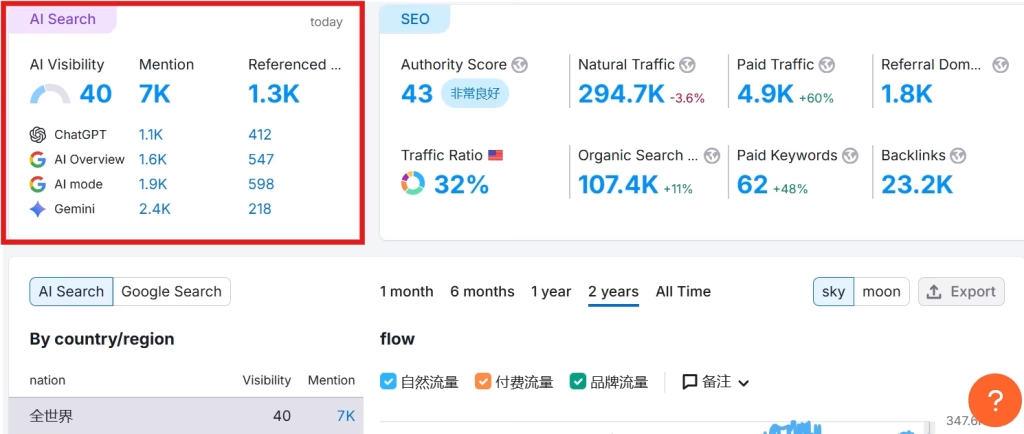
- Utilize SEO tools like Semrush, as it offers AI visibility performance tracking, the number of mentions, and the number of times your domain page is referenced in the AI-generated answer across different AI models.
2. Manual Audits:
- Enter a prompt in ChatGPT or Perplexity AI asking, “What is the reputation of my brand…” The AI model will provide you with a narrative report about your brand based on the web data.
- You can ask Perplexity AI or Gemini about something that your brand also offers. Then click on the citation number. If you find your brand, that means you have a good performance in AI search results.
Domande frequenti
1. Does “AI Mode” count as a click or a view in Search Console?
It counts as an AI Impression. A click is only recorded if the user expands the “Sources” or “References” list and selects your specific link.
2. Can you block AI bots from crawling your site?
Yes, via robots.txt (e.g., User-agent: GPTBot), but doing so makes your content “invisible” to these engines, which could significantly hurt your site’s discovery.
3. What is a good “Citation Rate” to aim for?
For your core industry topics, aim for a 15–25% Citation Rate. Top-tier authorities typically appear in over 50% of relevant AI responses.
4. Should you change your keyword strategy to focus only on long-tail conversational phrases?
You shouldn’t abandon core keywords, but you must shift your focus toward Natural Language Queries (NLQs).
Last Words
To stay visible in AI search results, stop focusing on keywords. Instead, focus on becoming a trusted, structured, and authoritative voice.
These common mistakes has great impact on your AI visibility and should not be undermined. Observe best practices to stay a relevant and authoritative source of information in ChatGPT, Perplexity AI, and Gemini.

 Danish
  Swedish
  Polish
  Korean