








The Future of Search: Rankings vs. Citations

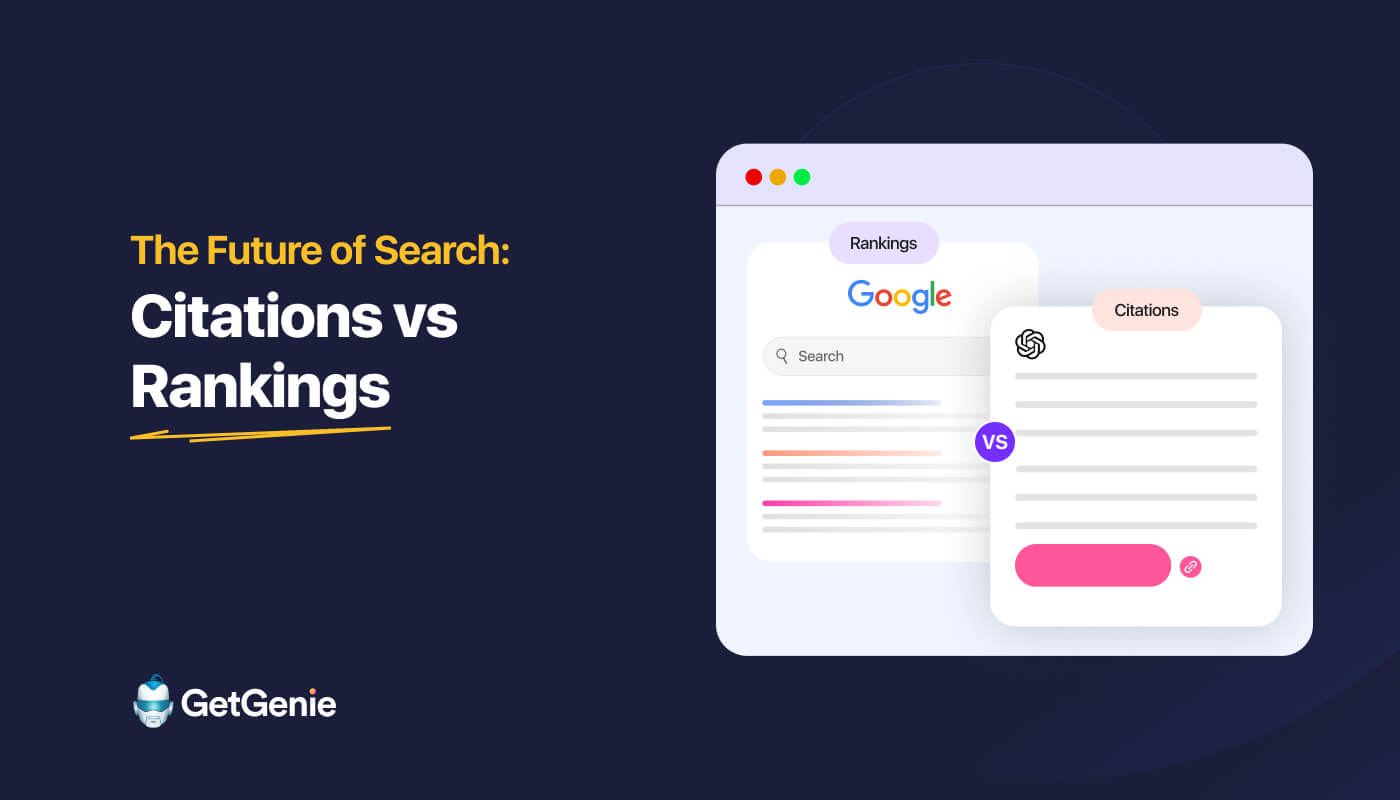
If you’ve been doing SEO for a while, you’ve probably felt that search doesn’t add up the way it used to. You optimize, you climb the rankings, maybe even hit the top three.
Yet, the traffic barely moves. Meanwhile, AI-generated answers start citing your competitors while your content gets overlooked.
It’s confusing because you’re doing everything “right,” but users still aren’t finding you. With AI platforms pulling citations from unexpected sources, the big question becomes: should you focus on rankings or chase citations for real visibility?
This blog post breaks down rankings vs. citations to let you understand what’s happening. And how to stay ahead as search evolves.
1. Ranking high in search means appearing high on traditional SERPs, where visibility depends on SEO factors like keywords, backlinks, topical authority, and overall content relevance.
2. Getting cited by AI refers to being referenced inside AI-generated answers (ChatGPT, Gemini, Perplexity, Google AI Overviews), even if you don’t hold a top SERP position.
3. Rankings depend on SEO factors like on-page optimization, backlinks, technical SEO, topical authority, and strong site structure.
4. Citations depend on content clarity and depth, expert-level explanations, structured sections, unique insights, and factual accuracy.
5. User behavior differs: Rankings rely on CTR from SERPs, while citations rely on placement inside AI summaries, attracting fewer but higher-intent clicks.
6. Both ranking and citation visibility have different stability: rankings fluctuate heavily; citations tend to last longer when content is evergreen, structured, and trustworthy.
7. The winning strategy (rankings vs. citations) is hybrid: optimize for SEO to rank while structuring, updating, and enriching content so AI models choose it as a cited source.
What Does Ranking High in Search Mean?
Ranking high in search is the traditional SEO model, where your webpage appears in the top positions of search engine results pages (SERPs).
Your visibility depends on how well your content matches the query, how authoritative your website is, and how strong your on-page and off-page optimization is. High rankings typically mean more organic traffic.
What Does Getting Cited in Search Mean?
Getting cited in search means being referenced by modern AI search assistants (like Google’s AI Overviews, ChatGPT Search, Perplexity, etc.).
In citations, your content is quoted, linked, or referenced inside an AI-generated answer, even if you’re not in the top 3 positions. Citations reward clarity, depth, originality, and topical authority.
Comparing Rankings vs. Citations
| Traditional Rankings | AI-Driven Citations |
| Works based on SERP position (Top 10) | Works based on relevance inside AI-generated answers |
| Heavy SEO optimization required | Heavy content depth & clarity required |
| Users click to visit pages | Users may get answers without clicking |
| Traffic depends on position | Traffic depends on mention placement & trust |
| Algorithmic & competitive | Contextual & intent-focused |
Rankings vs. Citations
Rankings show your visibility on search engines. And AI citations highlight your presence across AI Overviews and LLM platforms. Together, they shape your overall discoverability in both traditional and AI-powered search.
1. Visibility Model: Rankings vs. Citations
Rankings
Visibility is determined by your position on the SERP. Higher positions mean more impressions and clicks. And that enhances your site’s overall traffic. To push your rankings up on the search results, you have to ensure SEO-ready pages.
Ranking visibility on the SERP counts primarily on the following factors:
- On-page SEO (keywords, structure, E-E-A-T)
- Backlinks and topical authority
- Page load speed, UX, internal linking
- Competition for the query
And the good thing is that you can check & implement all these factors with a wide range of SEO tools.
Let’s say you want to optimize content with high-intent & relevant keywords and enhance EEAT. Holen Sie sich Genie will help you find impactful NLP, semantic & related keywords on your chosen topic. You can also build topical maps with the tool and create in-depth content.
Likewise, to measure page loading speed, you can use PageSpeed Insights. It will show you page performance metrics like accessibility, SEO, total blocking time, and more.
Citations
Visibility comes from being referenced inside AI-generated answers, regardless of your ranking position.
Citation visibility basically depends on the factors below:
- Content depth and topic expertise
- Clear, structured explanations
- Unique data, examples, or insights
- Trustworthiness and factual accuracy
2. User Behavior: Rankings vs. Citations
Rankings
Users typically scroll through search results and skim the top links, clicking on pages they trust or find relevant.
The click-through rate (CTR) drops drastically after the top three positions, highlighting the importance of securing a top spot.
Before clicking, users often compare titles to make sure the page matches their intent.
If a page doesn’t immediately answer the query, users leave quickly, resulting in a high bounce rate.
Citations
When it comes to citations, users usually read AI-generated summaries first.
They often trust the summary and only click on sources if they want more detail, data, or examples.
Sources that appear at the top or in a numbered list tend to get more clicks, as users prioritize the most accessible references.
3. Optimization Approach
Rankings
Ranking-focused optimization relies on proven SEO techniques. It improves pages, site structure, keywords, internal links, and backlinks to help your content appear higher on search results.
You have to apply the following SEO strategies to enhance your ranking chances:
- Keyword targeting & on-page optimization
- Technical SEO improvements
- Offpage SEO (Backlink acquisition)
- Optimized internal linking
No doubt, these strategies play a key part in optimization. But Google currently prioritizes content with unique angles that satisfy search intent, and address user needs & pain points to rank content higher.
Citations
Optimization focused on citations strengthens content quality itself. It uses clearer explanations, original insights, updated information, and unique value so AI systems choose your content as a trusted source.
To make your content citable, make sure it follows the points below:
- Use clear definitions, frameworks, and structured explanations
- Provide original insights & expert-level elaboration
- Add data, examples, or unique angles
- Keep content up to date and factual
So, some points between the citation optimization and ranking optimization are the same like providing unique angles, factual data, etc. But the former stands out from the latter by stressing on structured & answer-first content.
Structuring means adding proper headings, paragraphs, bullet points, or numbered points where it fits to make the content easy to parse for AI. And in answer-first approach, you have to first find all the questions related to your topic. And then, answer the questions straightaway in the best possible way.
4. Authority: Rankings vs. Citations
Rankings
In rankings, authority is built through high-quality content (topical depth) and also via external indicators like backlinks, & brand reputation.
Bear in mind, topical depth showcases your expertise across related subjects. This convinces search engines that you cover the topic thoroughly.
Also, quality backlinks is always a major authority signal. They help search engines trust your content more.
Besides, a strong brand reputation also boosts a site’s authority. Even if your site is new with limited site content & backlinks, it can still show up higher in ranks for relevant queries only because of higher industry standing.
Citations
For citations, authority depends on how effectively your content helps the AI models like ChatGPT, Gemini, Claude, etc. answer user questions.
AI models prioritize pages with expert-level explanations that offer clarity and depth. Trustworthy references improve reliability and increase the likelihood of being cited.
Also, structured sections (Discussed a few points abvoe) like definitions, steps, comparisons, or summaries make your content easier for AI systems to parse.
Unique research, original insights, or compiled data provide added value. This makes your content stand out as a preferred source.
5. Longevity & Stability
Rankings
Rankings are dynamic by nature. SERP positions shift frequently, sometimes week to week, especially in competitive niches.
Even small algorithm tweaks or new competitors can push your page up or down. This makes rankings powerful but volatile.
What performs today might slip tomorrow without ongoing optimization and monitoring.
Citations
Citations, on the other hand, offer more stability. If your content fits the answer patterns AI models prefer, like clear structure, factual accuracy, and strong definitions, it will stay relevant for longer periods.
Evergreen content is especially durable. Even after AI model updates, well-structured, low-misinformation content tends to hold its citation presence.
This gives Citations a “long shelf life” compared to SERP Rankings.
6. Traffic & Conversions
Rankings
Rankings drive traditional SEO traffic. That means users click directly from the SERP into your site. For traffic through ranking, CTR and on-page intent alignment play a crucial role.
Improving meta titles, tightening your first 100 words, and refining CTAs all help increase clicks and conversions. Also, better UX ensures visitors stay, explore, and convert.
Citations
When it comes to citations, they work differently. Your traffic comes from people clicking cited links inside AI-generated answers.
The volume is usually lower, but the intent is much higher because users click only when they’re genuinely interested.
To maximize citation-driven traffic, offer something worth exploring. Original data, visuals, frameworks, or downloadable assets make your page irresistible to curious users.
The more your brand stands out in AI snippets, the more high-intent visitors you gain.
7. Measurement & Tracking
Rankings
Rankings are easy to measure using premium SEO tools. You can track positions, impressions, and clicks using Google Search Console or even with GetGenie’s SEO Insights dashboard.
Track how your keywords move like whether they’re rising, stable, or dropping. Monitor impressions for visibility, and check CTR to see if titles attract clicks.
Identify pages gaining or losing positions and watch keywords in positions 4–15 for quick wins. Also review performance by device and country to catch shifts early.
Citations
Citations require a different approach. Since AI answers behave differently from traditional SERPs, you have to rely on AI search visibility tools and referral patterns for performance tracking.
Ahrefs & SEMRush show detailed analytics about your site’s citations on AI Overviews & LLM platforms like ChatGPT, Perplexity, Claude, etc.
You can find out an AI score based on visibility, cited pages on AI Overviews & LLM platforms, and understand your performance in AI search.
You can also manually check for citations on AI Overviews for relevant keywords. All you have to do is type your keywords in the Google Search Bar and spot your citations beside the AI answers.
FAQ (Frequently Asked Questions)
1. Are citations more important than rankings now?
Not necessarily. Rankings still drive significant traffic from traditional search, but citations boost credibility and visibility inside AI-generated answers. You need both for a complete search strategy.
2. Can a page get cited even if it doesn’t rank high?
Yes. AI assistants often cite pages that explain concepts clearly or offer unique insights, even if those pages are not in the top three search results.
3. How do I optimize content to earn citations?
Use clear definitions, structured explanations, up-to-date information, original insights, and content that directly addresses user intent. The goal is to make your content easy for AI to quote.
4. Do citations actually drive traffic?
Yes, although usually at a lower volume. The traffic is often more qualified because users click citations when they want deeper detail, reliability, or examples.
5. Which tools help track citations in AI search?
Perplexity’s analytics (when available), Bing Webmaster Tools, brand monitoring tools like Mention/Brand24, and Google Analytics referral paths. Manual checks inside AI assistants also help.
6. Will citations replace traditional SEO?
No. Traditional SEO remains essential for ranking-based visibility. Citations simply add another layer of influence, especially as AI-driven search continues to grow.
Zu dir hinüber
Rankings and citations aren’t rivals. In fact, they’re two sides of the new search ecosystem. Rankings still deliver dependable visibility and organic traffic. Contrarily, citations build credibility in AI-generated answers where users increasingly get their information.
So, the smartest approach is to create content that performs in both arenas. So, create content structured and optimized enough to rank and also clear, insightful, and original enough to earn citations.
Make sure to update outdated sections, refine explanations, add data or unique angles, and track how your content appears across both SERPs and AI tools will do the trick.

 Danish
  Swedish
  Polish
  Korean