








How to Optimize Existing Blog Posts for AI Search Without Starting Over


You do not need to rewrite your old blog posts to show up in AI search.
You need to refresh them the right way: protect what already ranks, fill the gaps AI answers reveal, and add information only you have.
That matters more every month. Google says AI Overviews has passed 2.5 billion monthly users. And according to Pew Research Center, users clicked a traditional result in only 8% of visits when an AI summary appeared, compared with 15% without one.
The good news? Your old posts already have what a new post must earn from zero: indexed URLs, backlinks, rankings, and authority. The goal is to upgrade them, not start over.
In this article, we will walk you through a five-phase refresh method you can repeat on any post.
Can You Optimize Existing Blog Posts for AI Search?
Yes. You can optimize an existing blog post for AI search by keeping its URL and best-performing sections, finding the questions AI answers cover but your post misses, adding original information and evidence, and restructuring key sections so they are easy to extract. A full rewrite is rarely needed.
Here is the method at a glance:
- Audit what already works
- Finden the AI information gap
- Hinzufügen information AI cannot easily replace
- Make the information extractable
- Validate and measure

Optimizing for AI Search Is Not Writing for AI
Optimizing for AI search means making useful information easier to find, trust, and extract. Writing for AI means producing text shaped primarily for a machine. The first approach is more durable because it improves the experience for both readers and search systems.
Low-quality GEO content adds keyword-heavy FAQs, robotic definitions, and “AI SEO” sections nobody asked for. The Princeton-led GEO study found that keyword stuffing offered little to no improvement in generative engine visibility.
So, keep one question in mind through every phase: would a human reader find this more useful? If yes, AI systems usually will too.
Phase 1: Audit What Already Works
Every existing post carries SEO equity. Your first job is to protect it.
Offen Google Search Console, filter by the page URL, and note its clicks, impressions, CTR, average position, and ranking queries. Then check which sections earn backlinks.
Now sort the post into three buckets:
| Keep | Verbessern | Remove |
| URL, ranking sections, backlinked sections | Weak answers, missing subtopics | Outdated claims |
| Original examples and data | Generic introductions | Repetition and filler |
Don’t rewrite sections that already perform. Keep the URL, keep the headings that rank, and edit winning sections carefully, not heavily.
One more signal to note: queries with high impressions but few clicks. They often point to questions your page does not answer well.

Phase 2: Find the AI Information Gap
This is where a normal content refresh becomes an AI search refresh.
Search your target topic in Google AI Overviews, ChatGPT, Perplexity, Und Zwillinge. Think of their answers as a public study guide for your topic. If every guide covers something and your post does not, that is a gap.
Look for:
- Questions your post never answers
- Entities and concepts you never mention
- Steps, comparisons, or definitions competitors include
- Follow-up questions the AI suggests next
For example, say you have a 2023 post on keyword research. If every AI answer now covers search intent, topic clusters, and AI Overviews, but your post only covers search volume and difficulty, you have found your gap.

Then compare against the pages that rank. You can use GetGenie’s SERP & Competitor Analysis Und Head to Head Analyse to see what top-ranking pages cover, which NLP keywords they use, and where your post falls short. Use the results as a research starting point, then decide which gaps actually improve the article, instead of adding every keyword or topic suggestion.

Remember, AI answers change daily. Your gap list tells you what to cover, not what will get cited.
Phase 3: Add Information AI Cannot Easily Replace
This is the most important phase in the entire method.
Filling gaps makes your post complete. But complete is not enough. If your post only repeats the facts every AI answer already has, it is easy to replace.
That is the difference between ranking content and citation-worthy content.
Information gain is what your post knows that others do not. Use this ladder to test every key section:
The Information Gain Ladder
| Level | What it is | Beispiel | Can AI replace it? |
| 1. Generic | What everyone says | “SEO is important for SaaS.” | Easily |
| 2. Useful | Specific, actionable advice | “SaaS teams should track organic conversions, not only traffic.” | Partly |
| 3. Original | What only you can know | Your own data, results, and lessons | Much harder |
Rule: Aim for at least one Level 3 insight in every major section where original evidence or experience is relevant.

What Level 3 looks like in practice
Imagine a plugin company refreshing an old post about SEO for WordPress plugins. (This is an illustrative example, not real company data.)
- Level 2: “Track installs and activations, not only traffic.”
- Level 3: “Our top-ranking tutorials kept growing traffic, but installs from them stayed flat. So, we added a first-setup section to each one and now report activations per post.”
Anyone can write the Level 2 sentence. Only that team can provide that specific firsthand observation.
Original frameworks count too. For example, in Why SEO Alone Won’t Grow Your WordPress Plugin Anymore on the Wpmet blog, we introduced the Plugin Growth Flywheel (SEO → Activation → Product Experience → Ecosystem → Brand) to explain what happens after the click.
Where to find your own Level 3 information
You probably have more original information than you think:
- Search Console: results from your past refreshes
- Product and sales data: usage and conversion trends
- Support tickets: real problems in your customers’ words
- Your team’s experience: tests and lessons learned
- Screenshots: proof that you actually did the thing
Back every important claim with evidence
Finally, ask one question about every claim: Can I prove this?
In the same GEO study, the top-performing methods were citing sources, adding quotations, and adding statistics, which boosted visibility by bis zu 40%. So, link primary sources with descriptive anchor text, and label what is fact, analysis, and opinion.
What Makes Existing Content Worth Citing?
No one can guarantee an AI citation, and no AI platform publishes its full formula for choosing sources. But after the first three phases, you can check your post against five traits that make it easier to cite:
Relevant + Specific + Evidence-backed + Original + Easy to extract
| Trait | What it means | Where you build it |
| Relevant | Answers the query and its follow-ups | Phase 2 |
| Specific | Concrete steps, numbers, and examples | Phase 3 |
| Evidence-backed | Claims linked to primary sources | Phase 3 |
| Original | Information only you have | Phase 3 |
| Easy to extract | Answer-first, self-contained sections | Phase 4 |

Miss originality, and your post becomes one more interchangeable source. For a deeper look, read what makes a website citable.
Phase 4: Make the Information Extractable
The goal is to make your best information easy for search engines and AI systems to understand and extract accurately. Structure only helps when the substance is already there.
Rewrite the introduction. Replace “In today’s digital world…” with Problem → Direct answer → What the post covers.
Use answer-first sections. Phrase key headings as questions, then answer in the first one or two sentences. Each section should make sense when an AI system pulls only that part.
Clean up the structure. Use a clear H2/H3 hierarchy, short paragraphs, and tables for comparisons.
Strengthen entity context. Link to related guides with descriptive anchors, and use consistent names. Write “GetGenie” every time, not “our tool” in one place and “the plugin” in another.
Add a small FAQ. Five real questions from People Also Ask, Search Console, and community threads beat twenty keyword-stuffed ones.
Phase 5: Validate and Measure
Before you hit Update, run the post through Holen Sie sich Genie inside WordPress:
- SEO Insights shows impressions, clicks, CTR, positions, and keyword cannibalization for your existing content.
- Inhaltsbewertung works on any post, whether GetGenie wrote it or not, and suggests on-page improvements.
- AI Readiness Score checks NLP keyword coverage, topical authority, and answer-first structure.
Treat these scores as a checklist, not a target.
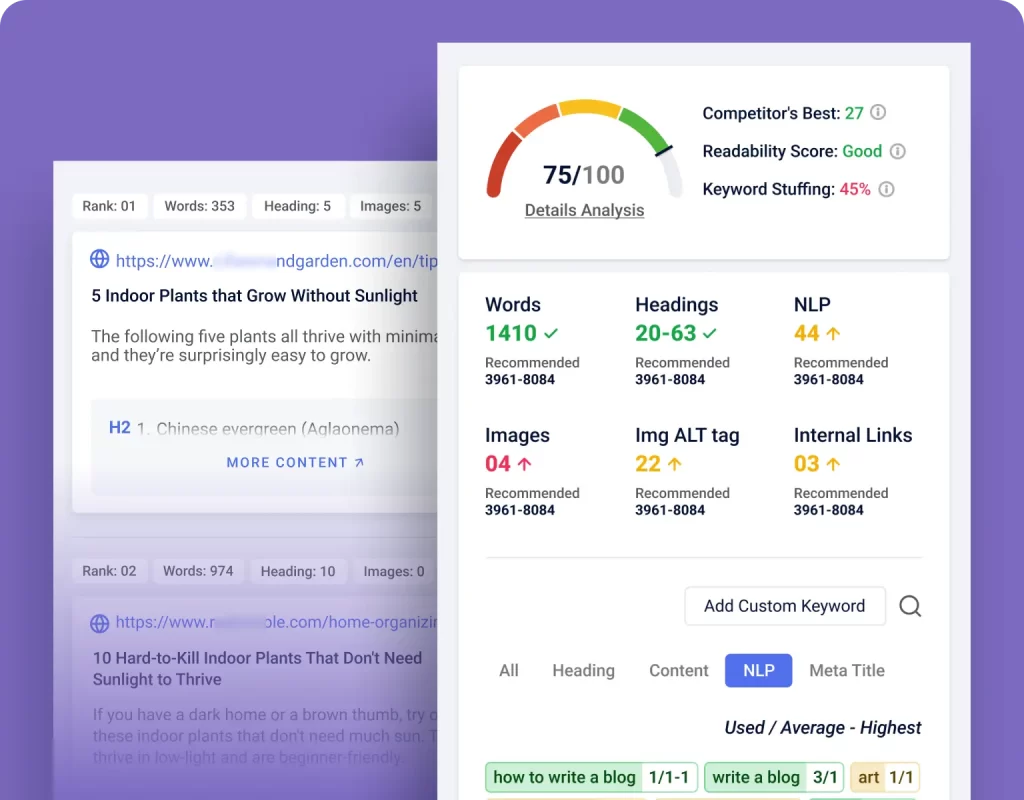
Basically, GetGenie speeds up research and optimization, but it cannot add your Level 3 information. No tool can. What makes a post worth citing is what only you know.
Ready to refresh your existing content? Use Holen Sie sich Genie to analyze the SERP, find content gaps, and optimize your post without rebuilding it from scratch.
Also, change the date only if the content changed. Google’s helpful content guidance warns against changing dates “to make them seem fresh when the content has not substantially changed.”
How to measure the refresh
Rankings still matter, but ranking #1 on Google is no longer the end goal. Track three layers:
| Layer | What to track |
| Traditional SEO | Impressions, clicks, CTR, rankings |
| Geschäft | Organic conversions and sign-ups |
| AI visibility | Mentions, citations, AI referral traffic |
AI visibility is still hard to measure consistently. Our AI SEO playbook shows how to track it in Search Console and GA4. Treat citations as a complementary metric, not a replacement for Search Console and conversion data.
The 30-Minute AI Content Refresh Checklist
Here is the whole method in half an hour:
| Time | Phase | What to do |
| 0 to 5 min | Audit | Check Search Console, backlinks, and sections to protect |
| 5 to 10 min | Find the gap | Check AI Overviews, ChatGPT, Perplexity, and GetGenie SERP analysis |
| 10 to 20 min | Hinzufügen | Add Level 3 insights where relevant, plus sources |
| 20 to 25 min | Extract | Fix the intro, answer-first headings, and internal links |
| 25 to 30 min | Validate | Run GetGenie, review manually, then publish |
A thin or badly outdated post will need more time, and that is fine.
Download the free 30-Minute AI Content Refresh Checklist
Use it to audit an existing post, find AI search gaps, add original information, and validate the refresh before publishing.
Final Takeaway
AI search does not mean starting your content strategy over. Your existing posts are assets.
Protect what works. Find what is missing. Add what only you know.
Not more words. Not more keywords. But more original information.
The easiest way to improve an existing post for AI search is not to make it more AI-friendly. It is to make it more useful, more specific, and harder to replace.
Which old post will you refresh first? Tell us in the comments. We would love to hear from you.
Frequently Asked Questions (FAQ)
How do I optimize content for AI search?
Start with what already works, find the questions AI answers cover but your content misses, and add original information and evidence. Then structure key sections so each one answers a question directly.
Does updating old content improve SEO?
It can, when the update adds real value, such as new information, better answers, or corrected facts. Changing only the date does not count.
How do I get my content cited by AI?
No method guarantees citations. However, direct answers, cited sources, statistics, and original information make your content easier for AI systems to trust and reference.
What is the difference between SEO and GEO?
SEO focuses on ranking pages in traditional search results. GEO (Generative Engine Optimization) focuses on getting content surfaced and cited in AI-generated answers. Strong GEO usually builds on strong SEO. For the full breakdown, read SEO vs GEO vs AEO.
How often should I refresh existing content?
Refresh based on change, not a calendar. Update a post when rankings or CTR drop, facts change, or AI answers cover topics your post misses.

 Danish
 Swedish
 Polish
 Korean